Showing posts with label Narrowboat. Show all posts

Friday, October 20, 2017

Rain, Rain, Rain

Ready for the rain
It did not always rain
Typical . . Blue skies followed by rain clouds
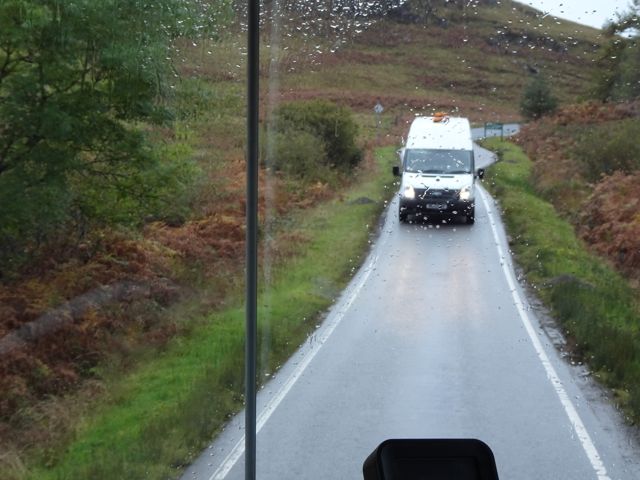
Rain on the bus
Rain on the lens.
If you have been following my Blog during this trip to the UK, you might have noticed that it has rained quite a lot. In fact, I believe it rained every day. The interesting thing is that the rain did not really affect us negatively so much. While on the boat, when it rains, someone is going to get wet. If you are driving the boat, you are standing outside on the stern, and if you are the lock crew, you are walking alongside the canal in the rain. Everyone was prepared for this with full rain gear, so no one really minded the rain.

Once we were off the boat and touring Scotland, the rain was very cooperative. It still rained every single day, but somehow it seemed to work around our schedule. It poured rain in the morning while we were eating breakfast, but stopped by the time we were heading out. Or, the day started out sunny, clouded over and suddenly the clouds opened once we got back to the apartment. Or, we stopped at a pub for a pint, and while relaxing with a good Scottish beer, a downpour happened out on the street. It was occasionally 'damp', but we never actually got rained on.
Then on the last day in Paisley, we got wet.  We arrived early, and got settled in before going out for dinner. The girl at the desk had given us a couple of interesting sounding options for dinner, but when we set out it was raining. It was actually pouring, a steady heavy rain. After weighing the choices we had decided on an interesting pub a short walk into town.

In a strange new town, in the rain, in the dark, with rain jackets zipped to the neck and hoods up it was difficult to navigate, and we were getting wetter and wetter as we looked for the pub. Were we supposed to go past the Cathedral, behind the Cathedral, or beside the Cathedral?

Then, through the rain, across from the Cathedral appeared one of the restaurants the hotel clerk had suggested. Not the pub we were looking for, but a modern, quite fancy restaurant called the "Pendulum". Wet and a bit frustrated I agreed to forgo my "pub" preference, and give this place a try.
Best dining decision of the trip! This place had an "Early Evening Menu" of three courses for £13. We had an amazing meal, probably one of the best of the trip, all because the Scottish weather finally decided not to co-ordinate it's downpour with our outings.


The meal was worth it.

Saturday, October 7, 2017

Turn The Thing Around


You are not going to turn around here
Our boat this trip is 70 feet long and 7 feet wide. The canals we cruise through are around 30 feet wide, although often much narrower due to bridges, moored boats, weeds and shallow areas, so do the math . . . . . you cannot turn around. You cannot start down one canal and decide “Oh, I don’t really like this scenery, I think I’ll turn around and go back.” On our first trip, we came upon two girls in a boat completely wedged across the canal; they thought they could just turn around, and required some assistance to get sorted out and back on course.

Fortunately, the designer of the canal systems took this problem into the planning, and
Sure not here either
periodically they placed “Winding Holes” which are wider basins where you can turn around. In our Canal Guide books, these winding holes are marked as a circle with a number in them indicating how long a boat can be if you want to turn around. The biggest winding hole I have seen was marked “70”, meaning a 70 foot boat can turn here.

Fortunately, you plan your trip carefully so you do not have to turn around very often, because it is a complicated procedure. We had to do it 3 or 4 times. Often you have to go down a branch to a town, and you have to turn at the end, but we had one corner that was so sharp you could not get around, especially in a long boat, so you have to go the wrong way for a bit until you can turn around
A bit wider, but still no room to turn
and come straight through the junction.

The other difficulty is that a 70 foot narrowboat steering with a tiller does not turn easily and has almost no control in reverse, so turning one around is a bit complicated. Fortunately we have had an experienced mariner on board (Bill), who is good at it, and we have generally handed the tiller to him when a complete change of direction was required, but this trip I was determined to learn as many things as possible, and this was one thing I wanted to do, so asked Bill for a lesson.

This is a winding hole
Here is the procedure . . . You enter the winding hole at a crawl, and turn the boat into the widest part of the basin, allowing it to swing as far as possible. Before you run aground, you throw it into reverse, but don’t bother trying to steer, just go straight back, giving yourself some room in the middle. Swing the tiller hard to pull the stern away from the way you need to go, and power forward. This swings the stern away, but makes the bow go in the direction you need to turn. Sometimes you can do it in one maneuver, but with a 70 foot boat you do not have a lot of room to work in a 70 foot winding hole.
Here I might be able to turn around

With Bill standing beside me, I managed it pretty slick . . . I hope I can get it the next time.

Friday, October 6, 2017

Cooking Local


Picking plums the narrowboat way
It seems to have become a “tradition” on these boat trips that “the guys” cook at least one meal. With some trepidation, John joined me on a shopping expedition and we bought some local pork, as well as some nice vegetables. Oh, and a bottle of wine of course. Our plan was to serve a nice roast pork with a glaze of mustard and maple syrup and some vegetables to accompany it.

Then along came Beeston Stone Lock. Regis drove into the lock and we waited while Shelly and John worked the lock. After a few minutes of waiting casually for the lock to fill, Shelly discovered that we were sitting under a plum tree, and she started reaching for branches to shake some plums down. Obviously, other narrowboaters had already picked the ones you could easily reach. After sampling one, she started searching the ground for more. The branches at the top of the tree were blue with plums, but it was impossible to reach them. Watching her try to reach the plums, I realized that as the boat came up in the lock I could use the barge pole to reach the top of the tree, so as Regis held the boat in the lock I climbed onto the roof and started hitting branches as high as the pole would allow me to reach. Shelly, still foraging under the tree was not aware of my plan until nice ripe plums started raining down on her. She ended up getting a good-sized bowl of nice purple plums.
Making Jam

Looking at the bowl of plums sitting on the table in the boat, I decided to take advantage of them and switched the recipe to a delicious plum glaze for the pork. I took the plums and boiled them down into a quite delicious plum jam. Instead of mustard we will try a plum jam glaze for the pork. And we ended up having plum jam for breakfast for the rest of the trip.

Hopefully “the girls” will enjoy our nice local cooking.

Tuesday, October 3, 2017

Engines and Old Boats

-->
Old Boats
We managed to arrive in Chester with some extra time, so decided to continue on down the canal to the end of the Canal at Ellesmere Port, where the Shropshire Union Canal actually meets the ocean and where boats on the canal would have picked up their cargo to be taken in to the cities and towns in England. In its heyday this port would have been bustling with activity, but now the ships sail by to load trucks which replaced the trains which replaced the canal boats. The area now is occupied by condominiums, a large modern hotel, and The National Waterways Museum. Hearing good things from fellow boaters, we decided to visit the museum while in Ellesmere Port.

The museum is a rambling complex of over nine building housing different aspects  of Inland Waterways history. There is a stable, a blacksmith shop, a woodworking shop, a basin full of old boats, a general history building, and my favorite, the engine room.

Many of the old boats were in terrible shape, and many were full of water. At least two were
Living Space for Narrowboat Family
sitting at the bottom of the basin completely submerged. One caused me some concern as I drove into the basin and found a smokestack sticking out of the water, and metal pieces just below the surface where I needed to go. Apparently there is a plan to move these poor old boats into a building where they can be preserved. There were a couple of original old working boats which you could enter to get a feel of how the families working these boats lived. Where we use the entire 70 feet of boat for our three bedrooms, two baths and full galley and lounge, entire families lived in an area smaller than one of our bedrooms. They needed the rest of the boat for carrying cargo.

Fire it up!
Most of the old boats on site are way to far gone to be restored and will simply be preserved for display, but the engine room was a different story. Here, dedicated volunteers have lovingly restored old boat engines to perfect working condition. There was a rainbow of colours with engines of yellow, red, blue, turquoise, and even black. The brass and stainless glistened and although these old engines would have thrown oil and grease around as they pushed the boats along the canals, these were polished and shining. They have all been restored to perfect working condition and are run regularly. When I was wandering around admiring the engine artistry, a volunteer fired up a huge single cylinder diesel engine. Watching him run through a complicated series of steps to get the engine going, I was happy to know that our little four cylinder engine started with a simple turn of the key. Although I enjoyed all of the museum, this room was my favorite.

And now, you will be subjected to pictures of engines.


Monday, October 2, 2017

Up, Up and Across

-->
Let's do it on foot first
Probably the high point of this narrowboat trip was the passage over the two big aqueducts on the Llangollen Canal. An aqueduct is simply a bridge to carry the canal over a road, river or in the case an entire river valley. The first is the Chirk Aqueduct, which carried an Iron trough upon 10 masonry arches 70 feet high and 710 feet long. It is over 200 years old, opened in 1801. There is now a railway viaduct running beside it. At the north end of the
Crossing the Chirk
aqueduct is a tunnel which runs for 421 meters, so depending on which direction you are coming, you navigate your boat 70 feet above a river valley and then enter a tunnel under a hill. One of our crew was both slightly claustrophobic and not fond of heights, so although I drove over and under the first time, I handed the tiller to him on the way back, thinking if he was concentrating on driving the boat he might not be so concerned.

That is a long way down
Although shorter at only 307 meters, the Pontcysyllte aqueduct is much higher at 127 feet, and much more dramatic because it is simply a metal trough sitting on 18 stone piers, so when you drive across you have to actually lean over the side of the boat to see the edge. It appears there is nothing holding the boat up.

This really is a dramatic experience driving a 70 foot long vessel across a bridge high above a river valley. You have to have confidence that the builder,
Across the Pontiunpronouncable

Thomas Telford built this structure to last over 200 years ago. Fortunately, the trough is barely wider than the boat, so you hardly have to steer, the trough guiding you across, and although it is difficult to cross without slight bounces against the sides, the trough has survived for 200 years and is still holding boats over 100 feet in the air.
I'm not scared . . .

Certainly an experience we will remember for many years to come.

Sunday, October 1, 2017

Underdressed in Chester


Cruising into Chester at twilight
Two years ago, following our last Narrowboat trip, we spent a week in the city of Chester, and really enjoyed it. While exploring the city we discovered that the canal runs right along the old city walls, so when planning this trip I worked Chester into it. After all, last time I was only able to visit about ten of the 50 pubs within the walled city.

Mooring by the city walls
This time, we cruised into the city and found a mooring spot right beside the city walls. A short walk along the canal and we went through the gate into the city. As soon as we found the old section of the city, we were surrounded by crowds of people all dressed up. Men in suits and women in evening gowns and high heels. Although it was pouring rain, no one was wearing raincoats, and only a few had umbrellas. It was cool, but most of the girls were dressed in just fancy dresses. This was not the Chester we recalled from two years ago. Looking for a place to eat was a challenge, as most places were packed and had long lines waiting.
Found a pub . . .

Finally finding a pub with a table for six, we asked what was going on. It was race weekend, and the big last horse race of the year at Chester Downs was tomorrow and everyone was celebrating.

Here we were all dressed for narrowboating in raingear (Yup, raining again today), so we really did not fit in with the crowds of race revelers in Chester this evening.

Lock Labor

-->
The first segment of this narrowboat trip was all about spectacular aqueducts, with a few
In the lock
tunnels thrown in for good measure. The second part where we went from Whitchurch into Chester was all about locks. We did a couple of single locks where our 70 foot boat just fits in, but a lot of the locks were double ones where two boats could fit in together. Most are made of stone and brick, but one was made entirely of Iron. All of the locks have unique features, making each one a little different. You never know what to expect until you get there, but enough us have worked enough locks that we have had no problems.

With six people on the boat we have become pretty efficient at working the locks. Here is a explanation of what is involved. Although all locks have a spot where you can pull over to let someone off to work the locks, we usually let someone off at the bridge before the lock and get them to go on ahead to get everything ready for the boat to go through.

Coming out
First you have to check if there is another boat which can use the lock first to take advantage of the water in the lock. If you are going down, and the lock is empty it is good to allow another boat coming up enter the lock and come up as you fill it. This time of year there are not as many boats on the canals, so only once have we had to do this and it was to our advantage. I arrived at a lock just as another boater was going to empty the lock to allow his boat to come up. I asked him to wait for our boat coming down and he happily did this. That way we slipped into the already full lock, emptied it, lowering our boat and then he came in to go up.

Normally you come to a lock and determine if it has to be filled or emptied. Each lock has
Another lock right ahead
doors on either end. The upper door is sometimes a single door as there is less water to go through at this end. The bottom doors are usually double. At each end there are paddles that allow the water in or out. If you need to fill the lock, you open the paddles at the upper end. If the lock has to be emptied the paddles at the lower end perform the task. These paddles are operated with a ratcheting gears drive that you operate with a special crank or “Windlass” which the crew always take off the boat with them. Some of the mechanisms are over 100 years old and sometimes a bit cranky. Our smallest crew member had to literally jump up to get enough leverage to move the windless.

Not getting much help here . . . .
Once the water level in the lock is equalized with the outside canal the doors can be opened. This is done via a foot square hardwood lever which is moved with sheer force. You lean back into it and slowly push it open by walking backwards on a short curved brick walkway. The doors will not move until the water is equalized and inexperienced or impatient lock workers can be seen trying in vain to push on the doors levers before they are ready. Once the boat leaves the lock, you close the doors, ensure all the paddles are closed and move on to the next lock.
Sharing with a swan

If the locks are not to far apart, the lock crew will usually just walk along the towpath to the next lock. With our six person crew, we often can send one person on to the next lock while someone stays behind to complete the lock labor on the lock the boat just left.

And then on to the next lock . . . .

Friday, September 29, 2017

But You Paid For a Ticket?


Walking the towpath
Although we are over here in the UK on a Narrowboat holiday, a lot of our time is spent walking. Sometimes you must get out and walk to operate the locks, raise lift bridges or check to see there are no boats coming the other way on narrow sections, but often people are just out walking because they enjoy it.

Under a bridge
Almost everywhere there is a canal, there is a “towpath” on one side of it. Originally the towpath was for the horses which pulled the narrowboats before they had engines installed. These towpaths go under the bridges, across the aqueducts and even through the shorter tunnels. No longer used by horses, these paths are well used by not only boaters, but also locals out for a stroll or walking their dogs, and often we will be moored out in the countryside, seemingly in the middle of nowhere and someone walking a dog will wander by the boat window.

Although the canals do run through cities, generally they are out in the countryside and you pass more cows and sheep than cars and trucks. Trees and hedges usually line the canals, so walking beside the canal is a very pleasant experience. As well, a canal has to be flat, so their routes were planned to never go over hills or into valleys. (The tunnels and aqueducts do that) As a result, walking the towpath is a pleasant stroll through the English countryside and there are no hills to climb. Most of us get out and do at least four or five miles and some have done over twenty miles every day, even in the “Welsh mist”. One of the crew, a non-fittbit-er has probably done more, as they walked for the entire  day.
The cows watch us pass

You might ask why are we walking when we paid for a boat hire. In fact while exploring the Great Orme in Llandudno, and three of the crew took the tram up the mountain (Well more of a pretty big hill . . . . ) and decided to get off in the middle and walk the second half, another tram rider questioned them “But why walk? . .  you paid for a ticket.” It is like that on the boat. Often there are more people out walking than on the boat, because walking the canals is a pleasant as gliding along in the boat.

Tuesday, September 26, 2017

Narrowboat Day Two


Walking the Aqueduct
This was the second day on the Narrowboat, and we went from England into Wales. We spent the night outside of a town called Chirk, and went to Llangollen. This was a particularly challenging section of the canal with two tunnels, two aquaducts, and two sections of single boat width canal. Only one bridge and no locks, but still plenty to keep us busy.

The canal we navigated today starts at Llangollen, and so all the water for the canal comes from here. This means that unlike most of the canals, there is current which complicates things at times. When the canals are narrow, the current will move the boat more than normal.
Underground in a Boat

For the uninitiated, an aqueduct is a bridge that allows the canal to cross a valley. The biggest, the Pontcysyllte Aqueduct, was built over 200 years ago with stone arches supporting the 125 ft. iron water channel carrying the canal 127 feet over a river valley. You come around a corner, the canal narrows, and you are suddenly floating in a narrow channel of water over 100 feet in the air. Although you know it is a bridge, and there is a walkway and rail on one side, on the other there is nothing. You actually have to peer over the side of the boat to see that you are on a bridge. I was driving the boat, but the crew was snapping photos and the folk walking across the bridge were snapping holiday snaps of us. I expect to see us on Youtube anytime now . . .
Traffic Jam! Bill got me through . . .

We navigated two tunnels, the longest 191 yards long, under a hill. These tunnels are arched brick lined structures barely wider than the boat. There are no lights but the boat has a headlight. Although I have never piloted tunnels, I have been through a few and knew what to expect as well as the principles necessary to get the boat through. Unfortunately the boat ahead of us did not really know what she was doing and went too slowly and ended up bouncing off the walls all the way. Unfortunately this along with the current flowing through the narrow passage made it difficult. If you maintain a certain speed you can get through more smoothly, but even our slightly claustrophobic crew member made it through, although I think I heard a sign of relief as we exited into the daylight at the other end.

Travel Gnome on the Aqueduct


As well there was about 700 yards of single boat width canal where the canal was cut from a steep rock hillside. Now a narrow canal is not really that hard, but this section twisted and turned making some tight turns that our 70 foot long boat could barely get around. These narrow sections require some planning, because you have to let crew ashore to go ahead and check for oncoming boats, and to stop any boats coming into the section while you are navigating it, because there is no passing room and it is almost impossible to back up.

It was a busy day, and mooring outside the town of Llangollen, I was happy to relax with a nice glass of wine as dinner was prepared from in the galley. 

Note photo four by Shelley Glover

Sunday, September 24, 2017

Bridgework

-->
Cows on a bridge
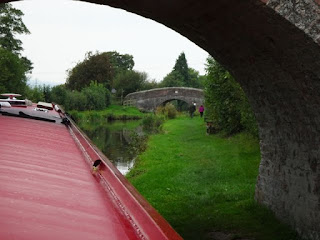
This is our third Narrowboat trip, My sister and her husband have done five, and our new friends have gone twice. As you pilot the Narrowboat through the UK’s canal system, bridges are a constant. There is a bridge every mile or so. Sometimes you have to actually pilot the boat across a bridge over a valley, but normally we are navigating the boat under the bridges. Now these bridges are very useful in navigating, because they are all numbered and you can track your progress and locate your position in the guide book by knowing which bridge you just went under. There are railway bridges, and motorway bridges, but the majority of the bridges crossing the canal are just bridges. They go nowhere; there is nothing on either end. Perhaps 100 years ago there was a cart road, but now there is just a field on either end of the bridge. We saw more cows on bridges than vehicles. And most of these bridges are old; crumbling brick structures arching across the canal no where near a road.

Now the boats are called “Narrowboats”, because the canals are narrow so the boats are only seven feet wide to allow two boats to pass in opposite direction on the canals. These bridges are even narrower, allowing only one boat to go under at a time. The canal under the bridges narrows to about nine feet, allowing only a foot at the most on either side. To compensate for being “narrow”, the boats are long, and with six people this year our boat is almost 70 feet long. For some reason, the bridges always seem to be positioned on a corner, so you are cruising along and you come around a corner to find a bridge in the middle of the corner. It is not easy to get a 70 foot long boat lined up to slip under a bridge that is only slightly wider than the boat. All the bridges sport scars from boats not being perfectly aligned and to see some of the scars, you have to wonder what the boats that made them look like. Sometimes you carefully get you boat all lined up to slip through and OOPS, there is another boat coming down who has the right-of-way and you have so quickly change course to let him through.
Two bridges in a row

But on our first day, we managed to successfully navigate three lift bridges, and under 45 regular bridges. We did run aground while trying to avoid a traffic jam at one bridge and we scared one of our crew who suddenly looked up to see the boat headed right into the side of a bridge (It was one that required a bit of a “tack” on a very sharp turn, and we actually made it through perfectly). Tomorrow we have two tunnels and two aqueducts to navigate, so there is always something to keep you entertained.

Friday, September 22, 2017

Four Countries in 24 Hours

-->
No toll to walk . . .
Well, we are off on our latest adventure, this one another Narrowboat trip. It is actually two trips, each a seven day excursion. We pick up the boat in a little town called Whitchurch, and we take seven days to go into Wales and back, including crossing one of the longest and highest aqueducts. Next we are going back to Chester England, a quaint little town we visited following our last Narrowboat trip. Two years ago, we spent a week in Chester and
A "Local" we met on a Walk
really liked it. While there, I noticed the canal system runs right into Chester, so I thought it would be nice to go back to Chester on the Narrowboat.

To start this trip we fly out of Halifax Canada direct to Glasgow Scotland, on an overnight flight, getting into Glasgow with the rising sun the next day. We then picked up rental cars and drove on the "wrong" side of the road with no sleep, down through Scotland and Western England and into Wales. So, in less than 24 hours, we were in four countries, Canada, Scotland, England and Wales.

The Whole Gang on the Pier
We pick up the boat on Saturday, so we are spending two days here in Wales, visiting a town called Llandudno (Don’t ask me to pronounce that . . . ) Here are a few pictures from the town.
Lifeboat Garage - Bill & John were excited!

Monday, September 19, 2016

Living on the Water

-->
Party Boat
One thing we have discovered since we started traveling is that we like being on the water. In Spain we were half a block from the Mediterranean, in Portugal we were in a fishing town, Budapest had us overlooking the Danube, Chester was on the River Dee, and living on a narrowboat for two weeks in England was a favorite vacation adventure. In Italy we were landlocked, and to be honest we missed the water.


Living on the Water
Now here we are off on a 43 day cruise across the Pacific Ocean to New Zealand, and will be on the ocean for weeks and weeks. What better way to start this adventure than a water taxi to Fisherman’s Wharf to see the floating homes there, and see how people actually “Live” on the water here in Victoria.

Watch out for float planes!
The weather forecast for Victoria was calling for rain, so we did not expect much, but although we woke to a downpour, the sun came out and we had a pleasant day. We walked down to the inner harbor across from the famous Empress Hotel, and caught a cute little water taxi out to Fisherman’s Wharf. Now there were a few fishing boats down at one end of the wharves but this is mostly a tourist attraction now, with floating homes, restaurants, and souvenir shops outnumbering the actual fishing boats.

Water Taxi
The water taxis are cute little boats that actually look too top-heavy to be seaworthy, but they scoot around Victoria’s harbor ferrying folks wherever they wish to go. In fact they even do a special Water Taxi Ballet in the summer. Check it out on youtube . . . Our taxi got us safely to Fisherman’s wharf, dodging float planes, ferries to Seattle, and various other Victoria Harbor watercraft, depositing us at the wharf, with a cheerful “See you on the way back”.

A house on a boat
Regis is a big fan of the many HGTV “Home Improvement”, shows including the “My Floating Home” series where they build houses that are moored in harbors, canals or rivers. Here at Fisherman’s Wharf we actually got to see some of these floating houses. It was interesting to wander down the wharf and see these unique homes. There was everything from a little Hobbit house to a converted boat with a huge party patio on the roof.

Our return water taxi pilot told us that one recently sold for around $250,000.00 and the monthly mooring fee is $800.00, so I do not think I am buying one any time soon.