I have always loved writing, and now that I am retired I thought I would be able to find time to write, but it seems that I still manage to fill my days with activities. I have however found that while I travel, I enjoy writing about some of the interesting things we do. I hope you enjoy reading of our adventures as much as I like writing about them.
Showing posts with label Wales. Show all posts
Friday, October 20, 2017
Monday, October 2, 2017
Up, Up and Across
![]() |
| Let's do it on foot first |
Probably the high point of this narrowboat
trip was the passage over the two big aqueducts on the Llangollen Canal. An
aqueduct is simply a bridge to carry the canal over a road, river or in the
case an entire river valley. The first is the Chirk Aqueduct, which carried an
Iron trough upon 10 masonry arches 70 feet high and 710 feet long. It is over
200 years old, opened in 1801. There is now a railway viaduct running beside
it. At the north end of the
aqueduct is a tunnel which runs for 421 meters, so
depending on which direction you are coming, you navigate your boat 70 feet
above a river valley and then enter a tunnel under a hill. One of our crew was
both slightly claustrophobic and not fond of heights, so although I drove over
and under the first time, I handed the tiller to him on the way back, thinking
if he was concentrating on driving the boat he might not be so concerned.
![]() |
| Crossing the Chirk |
![]() |
| That is a long way down |
Although shorter at only 307 meters, the
Pontcysyllte aqueduct is much higher at 127 feet, and much more dramatic because
it is simply a metal trough sitting on 18 stone piers, so when you drive across
you have to actually lean over the side of the boat to see the edge. It appears
there is nothing holding the boat up.
This really is a dramatic experience
driving a 70 foot long vessel across a bridge high above a river valley. You
have to have confidence that the builder,
![]() |
| Across the Pontiunpronouncable |
Thomas Telford built this structure to last over 200 years ago. Fortunately, the trough is barely wider than the boat, so you hardly have to steer, the trough guiding you across, and although it is difficult to cross without slight bounces against the sides, the trough has survived for 200 years and is still holding boats over 100 feet in the air.
![]() |
| I'm not scared . . . |
Certainly an experience we will remember
for many years to come.
Tuesday, September 26, 2017
Narrowboat Day Two
![]() |
| Walking the Aqueduct |
This was the second day on the Narrowboat,
and we went from England into Wales. We spent the night outside of a town
called Chirk, and went to Llangollen. This was a particularly challenging
section of the canal with two tunnels, two aquaducts, and two sections of single
boat width canal. Only one bridge and no locks, but still plenty to keep us
busy.
The canal we navigated today starts at
Llangollen, and so all the water for the canal comes from here. This means that
unlike most of the canals, there is current which complicates things at times.
When the canals are narrow, the current will move the boat more than normal.
![]() |
| Underground in a Boat |
For the uninitiated, an aqueduct is a bridge that allows the canal
to cross a valley. The biggest, the Pontcysyllte Aqueduct, was built over 200
years ago with stone arches supporting the 125 ft. iron water channel carrying
the canal 127 feet over a river valley. You come around a corner, the canal
narrows, and you are suddenly floating in a narrow channel of water over 100
feet in the air. Although you know it is a bridge, and there is a walkway and
rail on one side, on the other there is nothing. You actually have to peer over
the side of the boat to see that you are on a bridge. I was driving the boat,
but the crew was snapping photos and the folk walking across the bridge were
snapping holiday snaps of us. I expect to see us on Youtube anytime now . . .
![]() |
| Traffic Jam! Bill got me through . . . |
We navigated two tunnels, the longest 191
yards long, under a hill. These tunnels are arched brick lined structures
barely wider than the boat. There are no lights but the boat has a headlight.
Although I have never piloted tunnels, I have been through a few and knew what
to expect as well as the principles necessary to get the boat through.
Unfortunately the boat ahead of us did not really know what she was doing and
went too slowly and ended up bouncing off the walls all the way. Unfortunately
this along with the current flowing through the narrow passage made it
difficult. If you maintain a certain speed you can get through more smoothly,
but even our slightly claustrophobic crew member made it through, although I
think I heard a sign of relief as we exited into the daylight at the other end.
![]() | |||
| Travel Gnome on the Aqueduct |
As well there was about 700 yards of single
boat width canal where the canal was cut from a steep rock hillside. Now a
narrow canal is not really that hard, but this section twisted and turned
making some tight turns that our 70 foot long boat could barely get around.
These narrow sections require some planning, because you have to let crew
ashore to go ahead and check for oncoming boats, and to stop any boats coming
into the section while you are navigating it, because there is no passing room
and it is almost impossible to back up.
It was a busy day, and mooring outside the
town of Llangollen, I was happy to relax with a nice glass of wine as dinner
was prepared from in the galley.
Note photo four by Shelley Glover
Labels:
Aqueduct,
England,
Llangollen,
Narrowboat,
Tunnels,
Wales
Sunday, September 24, 2017
Bridgework
![]() |
| Cows on a bridge |
This is our third Narrowboat trip, My
sister and her husband have done five, and our new friends have gone twice. As
you pilot the Narrowboat through the UK’s canal system, bridges are a constant.
There is a bridge every mile or so. Sometimes you have to actually pilot the
boat across a bridge over a valley, but normally we are navigating the boat
under the bridges. Now these bridges are very useful in navigating, because
they are all numbered and you can track your progress and locate your position
in the guide book by knowing which bridge you just went under. There are
railway bridges, and motorway bridges, but the majority of the bridges crossing
the canal are just bridges. They go nowhere; there is nothing on either end.
Perhaps 100 years ago there was a cart road, but now there is just a field on
either end of the bridge. We saw more cows on bridges than vehicles. And most
of these bridges are old; crumbling brick structures arching across the canal
no where near a road.
Now the boats are called “Narrowboats”,
because the canals are narrow so the boats are only seven feet wide to allow
two boats to pass in opposite direction on the canals. These bridges are even
narrower, allowing only one boat to go under at a time. The canal under the
bridges narrows to about nine feet, allowing only a foot at the most on either
side. To compensate for being “narrow”, the boats are long, and with six people
this year our boat is almost 70 feet long. For some reason, the bridges always
seem to be positioned on a corner, so you are cruising along and you come around
a corner to find a bridge in the middle of the corner. It is not easy to get a
70 foot long boat lined up to slip under a bridge that is only slightly wider
than the boat. All the bridges sport scars from boats not being perfectly
aligned and to see some of the scars, you have to wonder what the boats that
made them look like. Sometimes you carefully get you boat all lined up to slip
through and OOPS, there is another boat coming down who has the right-of-way
and you have so quickly change course to let him through.
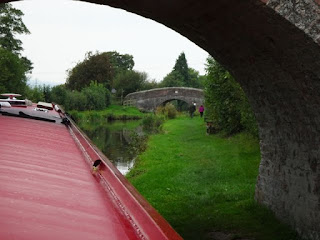
![]() |
| Two bridges in a row |
But on our first day, we managed to
successfully navigate three lift bridges, and under 45 regular bridges. We did
run aground while trying to avoid a traffic jam at one bridge and we scared one
of our crew who suddenly looked up to see the boat headed right into the side
of a bridge (It was one that required a bit of a “tack” on a very sharp turn,
and we actually made it through perfectly). Tomorrow we have two tunnels and
two aqueducts to navigate, so there is always something to keep you
entertained.
Labels:
Bridge,
Narrowboat,
United Kingdom,
Wales
Friday, September 22, 2017
Four Countries in 24 Hours
![]() |
| No toll to walk . . . |
Well, we are off on our latest adventure,
this one another Narrowboat trip. It is actually two trips, each a seven day
excursion. We pick up the boat in a little town called Whitchurch, and we take
seven days to go into Wales and back, including crossing one of the longest and
highest aqueducts. Next we are going back to Chester England, a quaint little
town we visited following our last Narrowboat trip. Two years ago, we spent a
week in Chester and
really liked it. While there, I noticed the canal system
runs right into Chester, so I thought it would be nice to go back to Chester on
the Narrowboat.
![]() |
| A "Local" we met on a Walk |
To start this trip we fly out of Halifax
Canada direct to Glasgow Scotland, on an overnight flight, getting into Glasgow
with the rising sun the next day. We then picked up rental cars and drove on the "wrong" side of the road with no sleep, down through
Scotland and Western England and into Wales. So, in less than 24 hours, we were
in four countries, Canada, Scotland, England and Wales.
![]() |
| The Whole Gang on the Pier |
Subscribe to:
Posts (Atom)


