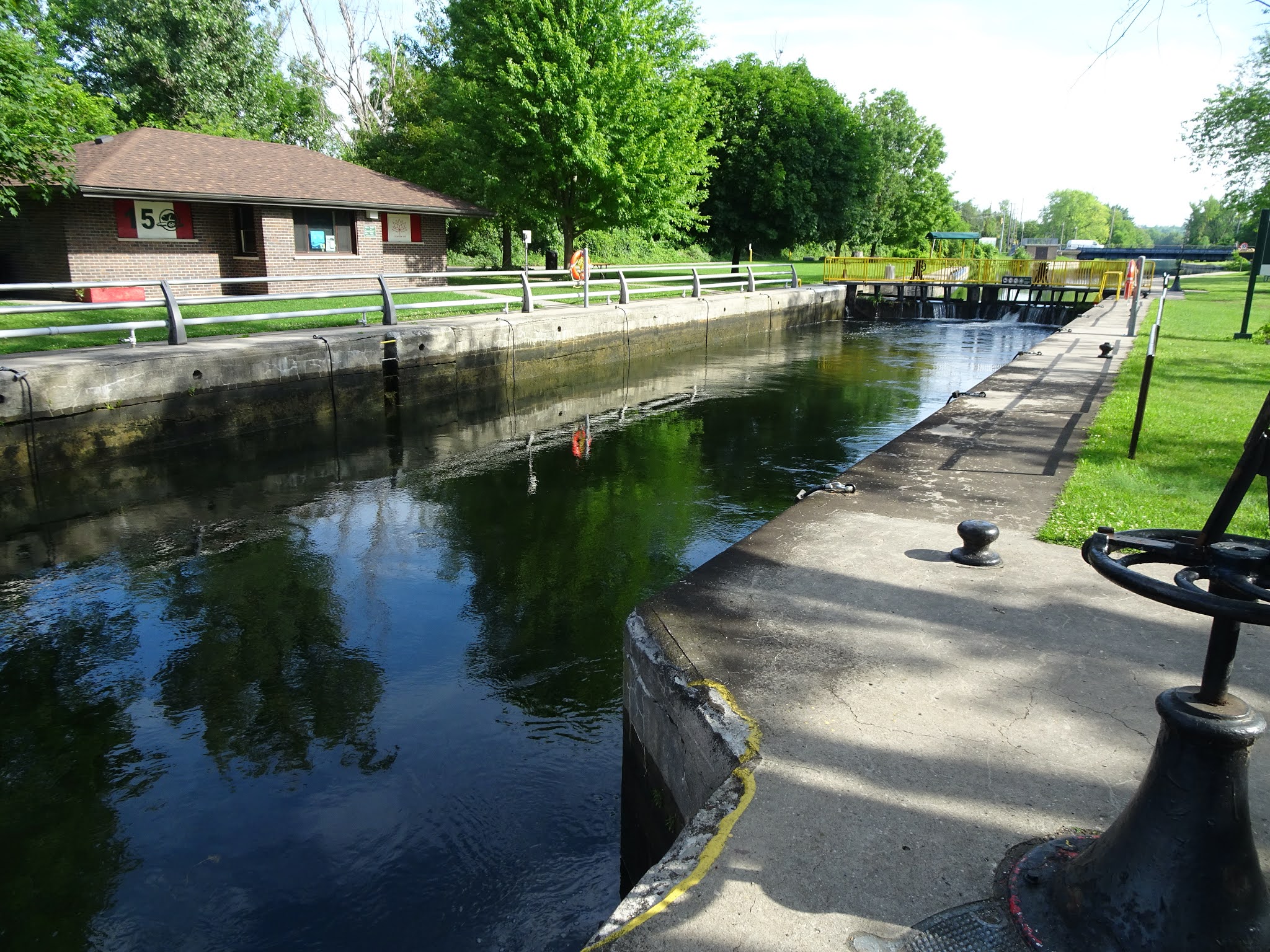
Showing posts with label Locks. Show all posts

Saturday, October 8, 2022

Going Down

White water in the lock

When we left Argens-Minervois, where we picked up the boat, we went up the Canal du Midi towards Toulouse. We also went through twenty four locks by the time we got to Carcassonne where we turned around. All of them were going up; we entered the lock empty and it fills with water to lift us up. As the water pours into the lock, you need to hold the boat in place with ropes, and at times it is hard to keep it from moving; we had Ryan and Ben well trained in this task by the second lock. I do not know exactly how much we climbed on the way, but some of the locks were pretty deep. 


At Carcassonne, we dropped Ryan & Ben off to explore on their own and we turned back to return the boat. We are now heading down the canal with just the two of us to do all the work, so we were a bit concerned about how we would do, but it actually turned out very well. 

This is much easier


When you are going down, you enter the lock with it full of water, so the “Crew” does not have to get off the boat before the lock. In fact we quickly discovered that we could just stay on the boat and throw the ropes off and around the Bollards on top of the lock walls. It is much easier to hold the boat in place when the water leaves the lock as when it rushes into the lock. Then, once the lock doors open, you just flip the ropes off the bollards, and motor out of the lock. The only reason we got off the boat was to give the lock keepers pins from back home. 


So, going down is WAY easier than going up.


Waiting for the lock

Cruising the canal

A calm early morning cruise in the rain

Piloting from the top

And from inside (out of the rain)


Thursday, October 6, 2022

More Lock Work

A lock on the Canal

I have written before about the locks on the canals in the UK, and the ones on the French canals are the “same but different”. They of course do the same thing, allow the boats to go up and down in elevation. They also work much the same with doors on either end to allow boats to go in and out and allow the locks to fill and empty of water. They are however much bigger with curved walls inside the lock allowing more than one boat in at the same time. The biggest difference is that all the locks we have encountered so far are operated by dedicated lock keepers who open and close the doors and control the water flow with remotes. They also direct traffic and control when you can enter the locks. Although the actual work of operating the locks is done by the lock keepers, the boat “crew” have to hold the boat in position while in the lock with ropes, so there is still work for the crew. Some of the locks have a system of lights telling you the status of the lock; two red lights mean it is closed, one red light means it is being prepared or being used by other boats, and a green light means you are good to enter the lock. 

The "crew" at work


Piloting the boat, you have to position the boat carefully to enter the lock through a narrow door and then maneuver to one side to allow another boat in beside you. Sometimes there are three boats in the lock at once, and if the boats were small four could fit. As the locks are filled or emptied of water, there is strong currents, so the crew must get off before the lock and then hold the boat fast to the side of the lock with ropes. Otherwise the boats would move around and bumping one another. 


The lock keepers also try to control the use of the locks so that more than one boat is going up or down at once. It takes a lot of water to fill a lock, so this is an effort to make things more efficient. 

Filling the lock (Going up)


After a few locks, everyone gets pretty good at the various tasks involved. I was able to get the boat in and out without scraping the sides, and the ropes rarely dropped into the water when tossing them up to the shore crew. But, at one point, two boats were in a lock going up and we realized that there were also two boats in a second lock coming down . . . . duh . . how does this work? The lock keeper coordinated everything, directing one boat to come into our lock in front of one of the boats then the boat beside, moved into the other lock and so forth until everyone was switched around and ready to move to the next lock. 

Sharing the lock


The only problem is that the boys are bailing on us in Carcassonne, and we will turn back to Argens-Minervois to  return the boat. With two less crew members, Regis is going to have to handle all the lock work or she is going to have to learn to pilot the boat into and out of the locks. 

The lock keeper's dog

Waiting for the lock to fill

Squeeze them in  

Hold her steady crew


Wednesday, July 14, 2021

Adding More Locks

You probably recall my previous posts about boat locks, so if this is of no interest to you, you may skip this post. Living in Dartmouth, close to the Shubenacadie canal system, I was familiar with locks and how they worked. I have been through the Panama Canal locks twice and enjoyed this experience greatly. I then started taking Narrowboat vacations in the UK, and learned by experience how the locks worked, as we actually worked many locks on our three trips there. A river cruise from The Netherlands to Hungary allowed me to experience a lot different and larger locks through Europe, and a cruise on the Nile added to the number of locks I have visited or passed through. Although I still have not actually counted the number, I expect it is close to 100. On this trip, I was able to add to that number by touring some of the Trent-Severn Waterway in Ontario. 

Waiting for the Lock to Open


My daughter and her husband live on a large lake in Northern Ontario and they bought a boat to enjoy the lake there and all it has to offer. Since we had not seen them in two years they decided to make this visit to Ontario extra special so they trailered their boat from Lac Seul to Peterborough where his family lives, and where you can easily access the Trent-Severn waterway. Our son-in-law, Derek offered to act as captain and tour guide so we loaded all six of us onto the boat along with the dog, and set out to spend the day exploring a section of the waterway. 


Although similar in design to the locks we experienced in England, these are bigger to accommodate larger boats, but are still operated by hand. Here I did not have to get out and actually operate the locks myself, strong young people were on hand to open and close the locks for us. I thought what a great summer job this must be; out in the fresh air meeting people every day, and the lock operators seemed to conform this with a seemingly genuine interest in the job. You were greeted with a smile and given a friendly wave as you left their assigned section of the waterway. Everyone was friendly and willing too chat and discuss their jobs with us as we passed through. 

Running the River


As we approached the first lock, we sounded a horn and the two lock attendants came out to greet us. They then allowed the lock to empty of water and we motored in. The doors closed and water gates were opened on the opposing doors, allowing the lock to refill, floating us up to the next level. This first lock was more complicated, as once we were through, one of the operators had to jump on a bicycle and pedal to the swing bridge a short distance along the canal which she then had to stop traffic and open to allow us through. As we were travelling on a slow Monday, with very little water traffic, the lock attendants phoned the next location and informed them we were coming so after having to wait at one lock, most of the others were ready for us and we did not have to wait for the lock to empty or fill. 

The Peterborough Lift Lock


There are 44 locks on this waterway, and we explored locks 21, 22, 23, and 24 before time made us turn back to get home before everything shut down for the day. Of these, lock 22 is probably the most interesting as it is a Lift lock, where you are lifted 60 feet from one level to another via hydraulics. There are two metal tubs of water that boats enter and as one is lifted the other descends. We experienced the Anderton boat lift in the UK that was 50 feet high but this one in Peterborough is higher by 10 feet. 


All in all, a great experience and a chance to spend time with family once again. And I got to add four more boat locks to my vacation adventures. 

The Swing Bridge 

Lock 21


Sunday, October 1, 2017

Lock Labor

-->
The first segment of this narrowboat trip was all about spectacular aqueducts, with a few
In the lock
tunnels thrown in for good measure. The second part where we went from Whitchurch into Chester was all about locks. We did a couple of single locks where our 70 foot boat just fits in, but a lot of the locks were double ones where two boats could fit in together. Most are made of stone and brick, but one was made entirely of Iron. All of the locks have unique features, making each one a little different. You never know what to expect until you get there, but enough us have worked enough locks that we have had no problems.

With six people on the boat we have become pretty efficient at working the locks. Here is a explanation of what is involved. Although all locks have a spot where you can pull over to let someone off to work the locks, we usually let someone off at the bridge before the lock and get them to go on ahead to get everything ready for the boat to go through.

Coming out
First you have to check if there is another boat which can use the lock first to take advantage of the water in the lock. If you are going down, and the lock is empty it is good to allow another boat coming up enter the lock and come up as you fill it. This time of year there are not as many boats on the canals, so only once have we had to do this and it was to our advantage. I arrived at a lock just as another boater was going to empty the lock to allow his boat to come up. I asked him to wait for our boat coming down and he happily did this. That way we slipped into the already full lock, emptied it, lowering our boat and then he came in to go up.

Normally you come to a lock and determine if it has to be filled or emptied. Each lock has
Another lock right ahead
doors on either end. The upper door is sometimes a single door as there is less water to go through at this end. The bottom doors are usually double. At each end there are paddles that allow the water in or out. If you need to fill the lock, you open the paddles at the upper end. If the lock has to be emptied the paddles at the lower end perform the task. These paddles are operated with a ratcheting gears drive that you operate with a special crank or “Windlass” which the crew always take off the boat with them. Some of the mechanisms are over 100 years old and sometimes a bit cranky. Our smallest crew member had to literally jump up to get enough leverage to move the windless.

Not getting much help here . . . .
Once the water level in the lock is equalized with the outside canal the doors can be opened. This is done via a foot square hardwood lever which is moved with sheer force. You lean back into it and slowly push it open by walking backwards on a short curved brick walkway. The doors will not move until the water is equalized and inexperienced or impatient lock workers can be seen trying in vain to push on the doors levers before they are ready. Once the boat leaves the lock, you close the doors, ensure all the paddles are closed and move on to the next lock.
Sharing with a swan

If the locks are not to far apart, the lock crew will usually just walk along the towpath to the next lock. With our six person crew, we often can send one person on to the next lock while someone stays behind to complete the lock labor on the lock the boat just left.

And then on to the next lock . . . .

Tuesday, September 15, 2015

Canal Camaraderie


Working the Locks

Although some of the books on Narrowboats and the English canals, do not speak rather fondly of “Hire-boat” people (That’s us, BTW), but we have had nothing but pleasant experiences with the people we have met so far.

You meet people when you are working the locks, and generally everyone co-operates and you help each other when more than one boat is going through. There is a certain polite protocol with how you use the locks and if you follow this you get along fine. To conserve water you always let a boat that can drive right in use the lock first even if you arrive there first. On the last trip, the locks were big enough for two boats to fit in side by side (As in the picture I included in the post on the locks), but on this section of canals, the locks are only big enough for one boat at a time. Consequently if you meet another boat coming up when you are going down or if you are in a queue for a lock going in the same direction, your lock workers hang around and help the other boat. If there is only one or two people on the boat they appreciate the help working the locks. Standing around waiting for the clocks to fill or empty is a good opportunity to find out what is down the line. Other boaters are more than happy to suggest pubs or good mooring spots.
Waiting for the Lock

Today we followed another boat down through the locks for a while, and we had a good chance to chat with them about the trip. One day when Bill was working the locks, a man with two children showed an interest in how everything worked and Bill suddenly had two eager pupils who even followed him up to the next lock to “Help” work the gates.

Quite the Audience.
Today I did my first “down” lock, and unbeknown to me, I ended up with a very rapt audience of keen observers. There was a group of about 15 hikers who had arrived at the lock and were very interested in how it worked. Regis, Bill and Margaret were working the lock and I was piloting the boat. Everyone was listening to explanation about how things worked and of course they all turned to watch me bring the boat into the lock. Fortunately I did this one very well, and eased it in smoothly (If not as fast as Bill can do) so I expect I looked okay. This was the first time our Canada flag was commented on, so the group knew we from “Across the Pond”.

Even the wandering bands of teenagers hanging around under the bridge by the tunnel were quite friendly. 


Monday, September 14, 2015

A Day the Narrowboat Way

-->
Our Home for Two Weeks
Although in many ways living on a narrowboat for two weeks is similar to spending time in an RV, there are also many differences. To give you some idea of what it is like I will describe what a day could be like.

If we have a lot of locks to work our way through, we will usually sit and have breakfast together. The boat has an apartment sized fridge working on LPG, so we have cold milk for cereal, butter margarine and jam for toast, or eggs and delicious English bacon. As well, a nice cup of coffee is needed to start our day even on the boat. If we do not have locks to navigate, Bill likes to get underway right away, so he or I go check the engine, start it up and we push off. Whoever is piloting the boat, expects his or her breakfast (or at least a hot cup of coffee) is delivered out to the back of the ship where the tiller is. The other option is to get the boat under way and then eat in shifts so the pilot can take a break to have breakfast.

If we do not have locks to go through, the person piloting the boat is the only one who
Ok, I think the pub is just up here . .
actually has to do much, and they have to be constantly alert; a momentary laps to watch the cows in the field next to the canal can result in running ashore. The canal is often barely two boat widths wide, and in places two boats cannot pass without running into weeds, so it does not take much to be into the banks. It is not usually a problem however and the boats all have a long pole to push you back off the bank. You can zip along at the dizzying speed of 4 MPH at times but when you are passing other boats, even moored ones, or houses, you are expected to slow down to 2 MPH, so people walking on the paths beside the locks often pass you. Although the pilot stands and steers the boat with the tiller, and occasionally adjusts the speed, they have to be constantly alert, and it is actually quite tiring if you have to do it for a long time. Normally we take turns so no one has to be at the tiller all day. The people not piloting the boat can sit and watch the countryside slide by, or they can read, play games or even write
Watch out for Wildlife
blog posts on the computer . . .

A day with locks is completely different. Every time you need to go through a lock, someone has to get out of the boat to operate the locks. They take a special crank or windless to open and close the paddles which allow the water into the locks or drain it out. One person can operate the locks, but it is easier with two because you need someone on each side of the canal. If it is just one lock the person piloting the boat lets the lock workers off before the lock and picks them up after the lock. However if there are a series of locks in a row as often happens, the lock workers may as well stay out and walk to the next lock. On the days when we had to do 18 locks, you spent most of the day off the boat working the locks or walking to the next lock. If the locks are close together it is useful to have more than one person, because one person can go ahead to prepare the next lock. You spend a lot of time standing around waiting for the lock to fill or empty so you can open the gates to let the boat in.
 
Keep to the Canal
Sometime during the day we just decide to take a break and pull over and make a cup of tea. Bill has discovered that the blackberries are ripe along the canal and there are buckets of them. Sometimes when we stopped he would disappear to go pick blackberries and we had no idea where he was.

Usually around 3:00 we will find someplace to pull over to moor for the evening. Although there are designated “mooring” areas in towns, you can normally stop almost anywhere along the canal. There is a walking path beside the canal; these paths are called “tow-paths”, because before engines powered the boats horses towed the boats along the paths. These paths are right beside the boat, and all evening people out walking, biking or exercising their dogs go by usually with a cheerful greeting. They are used to finding someone new parked beside the canals close to where they walk. If you are in a town, you might find an interesting pub to try for dinner but in the countryside someone has to prepare an evening meal.
Tying up the Boat

Then, especially on days when we had a lot of locks, everyone goes to bed early, to be rocked to sleep by the gentle motion of the water. You sleep pretty well after a busy day on the canals.

Becoming a Lock-Smith

-->
Working the Locks

Today I learned how to actually pilot the boat in and out off the locks. I have watched how it is done, but knowing that it can cause a serious problem if it is not done right, I was hesitant to do it myself. Today I asked the captain of the boat (That would be Bill), to give me instructions on how it was done. His instructions were excellent, but he guided me through one lock and then politely announced that he was going to go and work the locks leaving me to run the boat all afternoon. Obviously this was a good plan, and by the end of the day I was sliding the boat into the locks with barely a bump. These locks are very narrow, with room for only one boat and there are barely inches on either side, and only a few feet aft and astern. As well, it seems that they like to put the locks on a slight angle so you cannot go straight in, but need to turn in at the exact time. Of course, turning a 60 foot long boat on a dime is not easy. However, you do feel good when you finally slip the boat around a bend and into the lock without touching the sides.The rest of this entry I wrote at home giving you a brief explanation of the locks.
  
Cruising the Panama Canal
When you transit through the Panama Canal, the lock system is a big deal, and the real highlight of a cruise with hundreds of passengers trying to get the best spot to watch the ships guided through the locks. On our river cruise through Europe the locks were not even mentioned in the literature and we tended to slip through overnight as if they were an unwanted hindrance to our trip. On this trip, we have almost 100 locks to navigate on the 100 mile trip; only these locks we have to operate on our own. In their heyday during the industrial revolution when these canals were THE method of transportation, each lock had it’s own Lock-keeper who lived in a cottage beside the canal and worked the locks and maintained the canals and the locks. Now the locks sit lonely and deserted and the users need to know how to operate them if they want to use the canal system.

Fortunately it is not difficult, and we quickly caught on after the first one. Most of the locks operate in both directions, so if the canals are busy you need to be aware of boats moving in both directions and if the locks are wide enough and traffic is heavy you are encouraged to share the locks and conserve water. If you are lucky, the lock is ready for you as you approach, the doors are open, the water at the right level and you can pilot the boat right in. Someone has to get off the boat to operate the gates and doors, so you need to get close enough to the shore to allow someone to jump ashore. If you are going up you need an empty lock, if going down you need to start with a full lock.

Don't do this!
Once in the lock chamber, it is very important to hold the boat in the center of the lock. If too close to the doors at either end you can become swamped by the incoming water or hung up on the frame as the water goes down; neither is good! Once the boat is in the center of the chamber, the operator outside makes sure all doors are closed tightly. Then the gates in the doors are opened allowing water to either enter the lock or flow out. The gates are small doors in the larger swinging lock doors. The gates are operated by remote ratcheting gears, which the operator works with a lock “windlass”. As the small door opens water rushes into the lock if going up, or out if going down. The pilot of the boat has to carefully keep the boat steady against the in/out flow of the water with the engine or with ropes.
Typical British Locks

You quickly learn that the water on both sides of the doors must be equal before the big doors will open; the procedure cannot be hurried, water pressure will not allow the doors to move. The operator works the doors by leaning back into the large counter-balanced leaver attached to the doors, and pushing back along the track beside the lock, worn by hundreds of feet over a hundred years. Once both doors are opened the boat can motor out, the operator can jump back onboard and you can continue on.

If lucky you can then settle back and enjoy the rest of the trip, but on two days of our trip we have to repeat this procedure 18 times . . . . .

Saturday, September 12, 2015

Back to Plan A


Well, after completely changing our plans and developing a completely different route, we arrived today to pick up the boat and discovered that the broken lock would be fixed and navigable once again.

Leaving the Marina
We were a little concerned with Plan B as it took us right through Manchester and one section required us to do 27 locks in one day, as it is not recommended to moor the boat along the canal in Manchester. Although the city’s reputation has improved in recent years, it was not unheard for boaters to be treated rather violently by local gangs of teenagers when they tried to stay overnight in Manchester. The decision therefore was not difficult, and we decided to go back to our original plan and do the Four Counties Ring.  

Our boat was ready to go on time, and the fellow giving us instructions on the boat was very happy that we had done this before and knew most of the information. There were a number of other boats coming and going , but we were the first out of the Marina. Finally on the boat and underway. Yay!

On the Canal at Last
The day started out miserably, and we woke at the B & B to a downpour of rain, so resigned ourselves to the first day on the boat a wet one . . . but, by the time we picked up our groceries and celebratory libation, the rain had stopped and the skies were clearing, and we motored out of the marina under blue skies.

Traveling on the canals on a narrowboat is not at all like touring in a car. England is a very densely populated country, and you rarely drive without seeing houses, stores and industry, but on the canals you mostly motor slowly through the countryside, surrounded by fields and trees. Our boat is named “The Great Blue Heron”, and soon after leaving the marina, a blue heron lifted off from the side of the canal and flew over the boat – a good omen if there ever was one.

Making Friends Along the Way
We did pass by a rusting very shabby looking industrial complex, but quickly were surrounded by gently waving cat-tails, fields of corn, and huge trees with branches we had to duck to avoid as we glided by. The canals are narrow and we are often less than two feet from the sides so the purple flowers on the bank could have been picked as we went by, and we saw another boater who  had discovered a plum tree growing beside the canal and had stopped to pick a basket.

The first day was an easy one with only three hours and one lock to do, so we arrived at a pleasant mooring spot just outside Middlewich, and after a delicious dinner of English meat pies purchased at the street market before we left, we are relaxing in the boat.

Now tomorrow is a six hour day with 17 locks to navigate, so  . . . . .

Friday, September 26, 2014

Love Locks

Yea I know, it’s a really terrible play on words, but I couldn’t resist.

Beautiful View out our window
We have seen the locks of the Panama Canal twice, gone in from the Caribbean side once, and done a complete transit from the Pacific side. On those voyages the locks are the big attraction, and they are up front and center in the brochures and advertisements for these cruises. I developed an interest and respect for locks on the English Narrow Boat trip where I actually had to work the locks to get the boat through, and the town I call home used to have a lock system on its canals. I do not however recall Viking even mentioning the locks on this trip.

A Tight Fit
There are in fact over 60 locks the boat has to traverse during the 14 day journey. There are locks that slow the boat down through every section of our journey, but most are in the middle section and there are only a few during the last section on the Danube. The trip is however very well planned and many of the locks are scheduled during the night. The boat is amazingly smooth, so when I felt it hit something I investigated and looked out the window.  What I saw was a concrete wall inches from our cabin window. I could reach out and touch it (Although covered in green and brown river slime, this was not a real interesting option). A rare occurrence, the captain had nudged the side of one of the locks he has to go through. We went through ten locks that night, and they continued every 10 to 20 miles from then on. Expressing an interest in the locks, I was given a map showing the location of all of the  locks. Around Nuremberg they are spaced only a few miles apart. I wondered why at times we were dropped in one town and then picked up at another only 20 klm away. The reason is that it can take hours to get through the locks, so the captain goes through the locks while we tour interesting towns on foot or by bus. At one point we were gone all day, and the boat was still late picking us up 30 Klm away because of traffic through the locks.

For those unfamiliar with this use of the word lock, it is a section of a canal or a special enclosed section of a river where doors can be closed in front of and behind the ship and water can be pumped into or allowed to flow into the lock to float the boat to a higher level. In reverse, the ship enters the full lock on the high side, the water is allowed to drain out, thus lowering the boat to a lower level.

Bonus . . . A Castle and a Lock . . .
On a Panama Canal cruise the famous locks are the reason for the cruise so a lot is made of them; on this trip the locks are a necessary nuisance slowing us down, so they are basically ignored. Me I have an appreciation of the locks and how they work, and love watching the power of the water transfer the huge ship meters up or down to continue at a new level. I was surprised at how many people knew nothing about them, and the teacher in me momentarily came out of retirement and I happily gave lock lessons when questions were asked.

Tuesday, September 23, 2014

Love Locks


Cruising on a river is different in many ways from ocean cruising. One of the biggest advantages is that since rivers are such important transportation routes, they usually run through the central core of the cities. Cruising on the river means you dock right downtown, and avoid that ocean cruise essential, the taxi ride to get downtown. This was true in Cologne Germany, where we docked under one of the central bridges over the river and stepping off the boat we could walk to all the local attractions.
Love Locks in Cologne Germany

The next bridge down from the one we were under had an interesting story involved with it. A number of years ago, someone began a story that if lovers took a padlock up onto the bridge and securely locked it to the bridge and threw the key into the Rhine River, their love would last as long as the lock remained on the bridge. This has become a popular thing to do ever since, and even from afar, the bridge sparkles with the multi-coloured padlocks covering the walkway across the bridge.

After our guided walking tour of Cologne, we decided to walk across one bridge, along the other side of the river, and back across the Hohenzollernbruke where these ‘love locks’ were. It really is an amazing sight. There are thousands of padlocks adorning the fence separating the pedestrian/bike pedway/walkway from the train bridge. Although it started as simply attaching a padlock, it has now become a serious phenomena, with everyone competing to lock the best padlock to the bridge as if somehow the quality of the padlock improved your chances of a lasting relationship. Most are engraved with the lover’s names and there are many similar shiny coloured locks (I suspect some enterprising business will provide you with these custom engraved locks), but many are interesting antique locks, and some are huge, some tiny, some heart shaped some adorned with decorations. The fence is completely covered, and there is really room for no more locks, so now locks are attached to other locks, and they have started using chains to attach them higher up on the bridge supports, and these chains in turn are now becoming covered.
No Room Left

I know that something similar was started up in Ottawa Canada, but the Public Works there cuts the locks off, so I’m not sure what the message is there. Here in Cologne, it looks to me that all the locks have been left on the bridge.

Our guide claimed that some couples started using combination locks, so that if their love did not last they were able to go remove the now inappropriate lock. I’m not sure if he was joking or not . . . . .