Showing posts with label Museum. Show all posts

Wednesday, July 15, 2026

But its just about Cloth . . . .

You remember that great book I was writing about months ago, 111 Places in Toronto That You Must Not Miss? Well one of the suggested places was the Textile Museum of Canada. But really what would be interesting about a museum about cloth, so I always found other places here in Toronto to explore that sounded more exciting. Now I do sew myself, and I had very cool  embroidered bell-bottomed jeans back in the 60’s, and I have friends who are skilled artists in cloth, so I should have known better but this place got skipped for a long time. 


But after three years here, I have pretty well seen everything in the book that was easy to reach. I have actually explored 72 out of the 111 places in the book, so really, the useful utility of the book was wearing thin, and most of the ones I have not seen are in out of the way. places. So, one day in early spring, with nothing else planned, the Textile Museum got moved up the “to-do” list and we decided to go check it out. It is described in the book as, 


The Textile Museum of Canada is a small, niche museum that is big on beauty and colour - Renowned internationally for it’s diverse and relevant exhibits in addition to it’s innovative programming, a visit here is both educational and entertaining.”


Now I admit, I didn’t actually read the description before I decided to go or I might have made up my mind earlier, because that does sound pretty interesting; I saw “Textile Museum”, thought “cloth” and skipped to the next item. 


Checking the address, we found that it was conveniently located downtown within walking distance, just off Dundas St, between the AGO and city hall, so it was easy to find. It is located down a side street and in a building that appears to be an apartment building. You enter and climb upstairs to the second floor and are greeted warmly by enthusiastic volunteers.  


And the museum is not just cloth and thread, it contains an amazing collection of items and not all of them are even made of Textile. How about a child’s waterproof suit sewn entirely out of fish skin; I expect that would keep the rain away, or a tapestry created by an entire village featuring thousands of tiny beads. There were hooked rugs, elaborate wedding outfits and simply amazing textile art work. Some of the things on display literally had me staring in awe - how could they do this?


I discovered an entire section on rug hooking and my grandmother did some amazing hooked rugs that she created using wool from her own sheep that she dyed herself and as kids we actually watched Scenes from Nova Scotia as we climbed the stairs to go to bed when visiting her. I found her old worn stair climber when cleaning out her attic and I have kept it,  so I even spoke to some of the volunteers about donating some of her work. 


There are pieces from all over the world, and most are really beautiful and truly amazing. Not only do they have a wonderful collection of textile artwork on display, they also maintain an extensive  collection in storage, and as you finish your tour you emerge to a workshop where weaving, rug hooking and other textile workshops are held. 


So if you are visiting Toronto and have any interest in textile art, the museum is certainly worth a visit. 


Thursday, February 1, 2024

Not the King

Following another suggestion taken from “111 Places in Toronto That You Must Not Miss”, we walked down to visit the Mackenzie House Museum which was not far from the condo. It was a damp day with rain threatening so we did not want to venture too far. 


Mackenzie House Museum

Sandwiched between another old house and overshadowed by a massive new condo construction we located the narrow brick house identified by a nice “Free Admission” sandwich board out front. The museum signs all said “open” and clearly pointed to an entrance door which, when tried was securely locked. Slightly confused we turned to leave, but noticed a friendly face inside waving and gesturing for us to come back. 


After an apology for the locked entrance, we were welcomed to the museum and offered a guided tour. Our friendly museum employee, was a cheerful young lady who really seemed to enjoy her job as she guided us through the house. 


The Mackenzie house museum was the home of William Lyon Mackenzie. He was the first mayor of Toronto as a city, a newspaper publisher and the grandfather of William Lyon Mackenzie King, the tenth Prime Minister of Canada. 

A really good guide


The house tour itself resulted in another apology from our guide, for the house had suffered serious damage from a flood caused by a faulty sprinkler system and many walls and ceilings had to be torn out and the furniture had been moved to storage. As a result pre-flood photos and descriptions from our helpful guide allowed one to imagine what the house must have been like. Having done a bit of framing and carpentry in my time, I actually enjoyed seeing the exposed skeletons of the rooms and the talented commentary of our guide filled in the missing plaster, wallpaper, and furnishings. 


I assumed that as a newspaper publisher and city mayor, the home owner would have been wealthy but in fact Mr. Mackenzie struggled financially all his life and this house had been purchased for him by supporters and he had difficulty maintaining it. At one point he had to let their maid go because he could not afford to pay her, and the family lived in only a section of the house in the winter to cut down on heating costs. 

A house in need of repair


Attached to the house was also a replica of the sort of printing facility Mr. Mackenzie would have used. His actual printing press was located in another building downtown, but the various authentic period printing machinery gave a picture of how Mr. Mackenzie made his living. Our guide demonstrated the printing press and we left with a printed copy of one of his newspapers. 


I had expected that the museum was dedicated to prime minister William Lyon Mackenzie (King), but the information about his grandfather was very interesting and I walked away with a greater understanding of this city and it’s history thanks in large part to our really dedicated tour guide. 


The front room (Use your imagination)

The kitchen in the basement


The Printing Press

Printing equipment

Printed papers

Just a nice picture

Tools of the trade

Wednesday, January 31, 2024

Aga Khan

The Aga Khan Museum & Park
Continuing through the “111 Places in Toronto that you Must Not Miss”, we decided to head out to visit the Aga Khan Museum located in Don Mills, a Toronto suburb. It involved a subway ride of 7 stops and then a 20 stop bus ride for almost and hour, but sounded like an interesting place. The book actually suggested a visit to the park surrounding the museum, but we figured we might as well make it a day and visit the museum as well which also featured an excellent restaurant for lunch. 


I really did not know what to expect from the Museum; I had heard of Aga Khan,

Eager Visitors

but did not know much about him. After visiting the museum, I came home and did some research to find out more. The Aga Khan is the traditional head of the Ismaili islamic religious people. The Ismaili are an esoteric non-conformist branch of islam that is actually more like Hinduism. Although the Aga Khan was born in Switzerland and actually lives and works from Portugal, his followers are located in countries all over the world. He is one of the richest “Royals” in the world, with his wealth coming from donations from his 15 million followers worldwide. Although he does enjoy the life of a wealthy aristocrat, he is well known for using his wealth for many worthwhile projects around the world. The Aga Khan Museum is one of his projects.

Entry to the 'Night in the Garden of Love"


The museum itself is amazing. It is situated in a large park and the building is modern, beautiful and an example of a “Money is no object” building project. As you walk in you are presented with a wide open spectacular structure. It contains the actual museum, an auditorium, a teaching area, a gift shop wth gifts I could never afford, a restaurant and various areas for temporary exhibitions. The museum itself is actually a small part of the complex. Nothing is crowded here; there are open spaces everywhere, including a huge open courtyard in the middle open to the sky. 


The Actual museum contains artifacts collected from around the world about the Ismaili religion and culture, and wandering through, I really did feel I was getting a better understanding of their history and culture. The collection contains many beautiful, intricate wood, ceramics and metal pieces from all over the globe as well as various ornate copies of the Qur’an and other Ismaili literature. Another room contained a beautiful collection of ceramics, and the Temporary exhibition featured a multi-sensory presentation by two artists entitled “A night in the Garden of Love”


We spent most of the day exploring the museum, with a break for lunch in the restaurant which is decorated with 200 year old panels donated from an Islamic mansion. I left feeling I knew a lot more about the Ismaili religion and culture; Regis felt the same, but she was also a bit dizzy from the virtual reality part of the “Night in the garden of Love”.


Below are some photos from the museum. 


Tuesday, September 20, 2022

Narbo Via

This is how the museum is presented?

When you ask about “attractions” in Narbonne, you are presented with the Archbishop’s Palace, the Cathedral, The Horreum (The underground warehouse), and the Narbo Via museum. We visited and really enjoyed the palace, the cathedral, and the Horreum as well as the Archeological site I wrote about previously, but to be honest the Narbo Via museum just looked like a big modern building with rows and rows of metal shelves holding pieces of stone from the vanished Roman city that was once Narbonne, so I was not so keen on going there. 

The Main Entrance


However, the nice little English guide at the Archeological site told us that many of the art works and interesting pieces she was telling us about that had been found at the site were now housed in the Narbo Via museum, so we revised our plans and decided to visit.


First impressions are good, as it is a spectacular modern building of glass and steel, unlike the old buildings we had been experiencing in the central part of town, and as you approach, you have to walk down a long wide walkway to get to the entrance which instead of being on the front, is on the side. 


One of the 760 stones

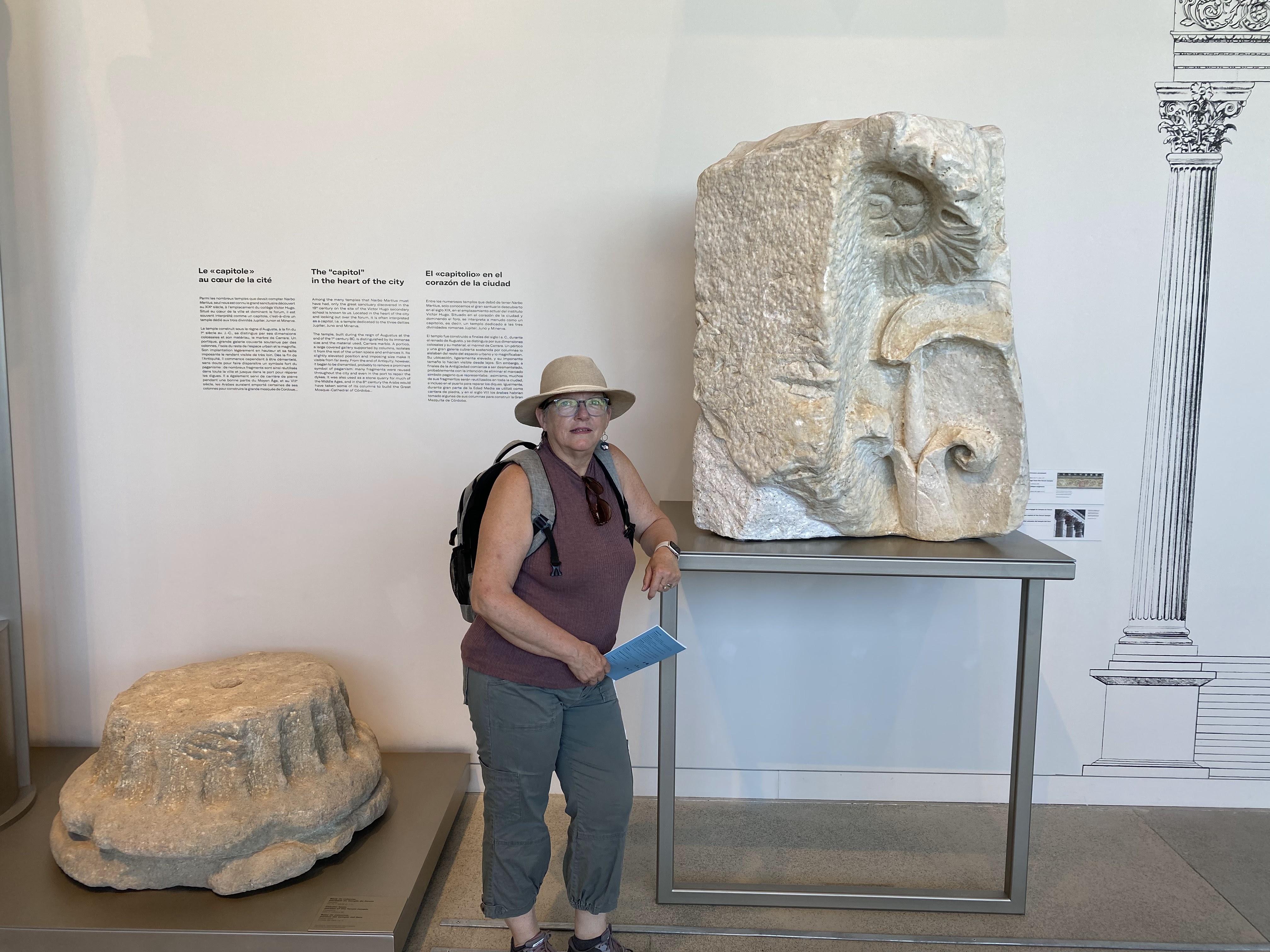
Now, the main part of the museum is indeed, a wall of stones, but it is really amazing, 76 metres long and 10 metres high, holding 760 blocks from the ancient Roman city. Just walking down and looking at the ancient stones is interesting, but you can also go to video terminals and pick many of the stones to examine closer via vivid photos that can be manipulated by spinning and turning then 360°. The booklet & map also explains that they have adapted an industrial robot crane that is able to pull any of the stones out for further closer study by the archeologists.


A bigger stone block
Once you finish with the wall of stones, you enter a series of rooms and digital alcoves that explain the history of the Romans in Narbonne, from earliest, to the decline in Christian times. These rooms contain larger stones and statues that do not fit into the wall of stones, and really gave a good picture of the splendour that Narbonne was in Roman times. One of these rooms displayed all of the artifacts that had been unearthed at the Archeological site we visited and rooms from the two houses that had been discovered were recreated to display the artifacts. 


Another headless Roman

The digital video alcoves were particularly interesting because here many of the buildings of Roman Narbonne were digitally recreated. I found it interesting to see the houses we visited at the dig site recreated in video. One alcove provided a video tour through the Roman city. One section showed a 3D map of what it was thought the ancient Roman city would have been like. All of what is now central Narbonne was part of the old Roman city and from what I could interpret the apartment we are renting is built over one of the major buildings in the Roman city. 


In many cities the actual remains of Roman structures have survived. Rome had the Coliseum and many other structures, we visited the old Roman baths in Bath, England, and the walls in Chester, England, but nothing remains above ground here in Narbonne. The Roman history is here, but you have to visit the museums to experience it. The Narbo Via Museum really was an educational and enjoyable way to spend a Narbonne morning.

Recreation of one of the Roman rooms

A video tour of ancient Roman Narbonne

A beautiful tiled floor found at the dig site


A bearded tourist examines the "Bearded Roman" stone

Friday, October 13, 2017

Brian, Your House Needs Work . . .


The dog-stone and Dunollie
Back in “New” Scotland (Nova Scotia), we have friends with the surname of MacDougall, so when we discovered that the ancestral home of the MacDougall Clan was just down the road, we figured we’d wander over, drop his name and have a visit. It sounded like pretty swanky digs, high on a hill overlooking the mouth of Oban Harbour.

The Dunollie Castle, House and grounds remains the ancestral home of the Clan MacDougall, but the house is now mostly a museum, and the castle a majestic ruin on the
The remaining tower
hill. The house contains some interesting historical artifacts, and allows you to see some of the rooms in the old house. In one room there is a most amazing collection of over 5000 wooden spoons from the collection of Hope MacDougall, and another area displays shoes and shoe makers tools.

The Castle ruins
A climb up to the castle reveals the “consolidation” of Dunollie Castle. This means that the castle is too far ruined to be restored, so it has been stabilized and the remaining structures have been made safe for people to visit and explore. There really is not much left, just one tower, part of another and a small section of wall. It is not surprising, since the history on a handout seem to indicate that the Clan MacDougall ended up on the wrong side of Scotland’s rulers on a number of occasions and lost all their ancestral lands at least twice.

Beautiful View
Walking down from the castle, you can wander through a beautiful willow garden where a local Girl Guide group had decorated a tree with painted wooden spoons, inspired perhaps by Hope MacDougall.

I was hoping to catch my friend Brian MacDougall at his ancestral home and thought I might share a wee dram with him, but mentioning his name did not even get me a reduced admission price, I had to play the “Senior” card to get a discount.
Some spoons for Mrs. MacDougall's collection

Tuesday, October 3, 2017

Engines and Old Boats

-->
Old Boats
We managed to arrive in Chester with some extra time, so decided to continue on down the canal to the end of the Canal at Ellesmere Port, where the Shropshire Union Canal actually meets the ocean and where boats on the canal would have picked up their cargo to be taken in to the cities and towns in England. In its heyday this port would have been bustling with activity, but now the ships sail by to load trucks which replaced the trains which replaced the canal boats. The area now is occupied by condominiums, a large modern hotel, and The National Waterways Museum. Hearing good things from fellow boaters, we decided to visit the museum while in Ellesmere Port.

The museum is a rambling complex of over nine building housing different aspects  of Inland Waterways history. There is a stable, a blacksmith shop, a woodworking shop, a basin full of old boats, a general history building, and my favorite, the engine room.

Many of the old boats were in terrible shape, and many were full of water. At least two were
Living Space for Narrowboat Family
sitting at the bottom of the basin completely submerged. One caused me some concern as I drove into the basin and found a smokestack sticking out of the water, and metal pieces just below the surface where I needed to go. Apparently there is a plan to move these poor old boats into a building where they can be preserved. There were a couple of original old working boats which you could enter to get a feel of how the families working these boats lived. Where we use the entire 70 feet of boat for our three bedrooms, two baths and full galley and lounge, entire families lived in an area smaller than one of our bedrooms. They needed the rest of the boat for carrying cargo.

Fire it up!
Most of the old boats on site are way to far gone to be restored and will simply be preserved for display, but the engine room was a different story. Here, dedicated volunteers have lovingly restored old boat engines to perfect working condition. There was a rainbow of colours with engines of yellow, red, blue, turquoise, and even black. The brass and stainless glistened and although these old engines would have thrown oil and grease around as they pushed the boats along the canals, these were polished and shining. They have all been restored to perfect working condition and are run regularly. When I was wandering around admiring the engine artistry, a volunteer fired up a huge single cylinder diesel engine. Watching him run through a complicated series of steps to get the engine going, I was happy to know that our little four cylinder engine started with a simple turn of the key. Although I enjoyed all of the museum, this room was my favorite.

And now, you will be subjected to pictures of engines.