Showing posts with label Walking Tour. Show all posts

Wednesday, September 20, 2023

Another City of the Dead

Toronto's Necropolis

On a previous visit to Toronto, I discovered that Toronto has a Necropolis, like in Glasgow Scotland. Necropolis means “City of the Dead”, and Toronto’s version is in Cabbagetown, not far from the condo, and I discovered that Heritage Toronto had guided walks focused on the black history in Toronto’s Necropolis. 


This cemetery is a non-profit nondenominational one and a wide range of folk are buried here, many being moved from an older city cemetery. There are over 50,000 souls buried here, many in unmarked graves. These cemeteries were often used for the dead who could not afford an expensive burial, but it is also a beautiful spot in a lovely location so many prominent members of Toronto society elected to be here as well. In fact on our first visit here on an earlier trip to Toronto we discovered Jack Layton’s memorial is here as well as Roy Brown who was the WW1 pilot who shot down the “Red Baron”. This guided walk featured information about members of the black population of Toronto who were interned here. 


Our first stop was the memorial to Thornton Blackburn (1812–1890). He was a former slave who escaped to Canada and established the principle that Canada would not return slaves to their “owners” in the US, thus making Canada a safe haven for escaped slaves. Blackburn established the first cab company in Toronto and became very wealthy and respected in the community. The current colours of the Toronto Transit Commission still mirror the colours Blackburn used for his cabs. His gravesite holds not only his family but also many other members of the black community. 

Shipped to Canada

The next stop was a marker for Henry Box Brown, who is famous for escaping slavery in the US by shipping himself in a box to Toronto in 1848. Thus his nickname of “Box”. He became a lecturer and entertainer in Toronto. 


We next visited a small marker that you could no longer read for the first black millionaire in Toronto, James Mink. A movie “Captive Heart” was made about him selling his daughter to a white American who then sold her into slavery in the US, and he had to go rescue her, but apparently it was a complete myth and in fact his daughter was married to a black resident of Toronto. 
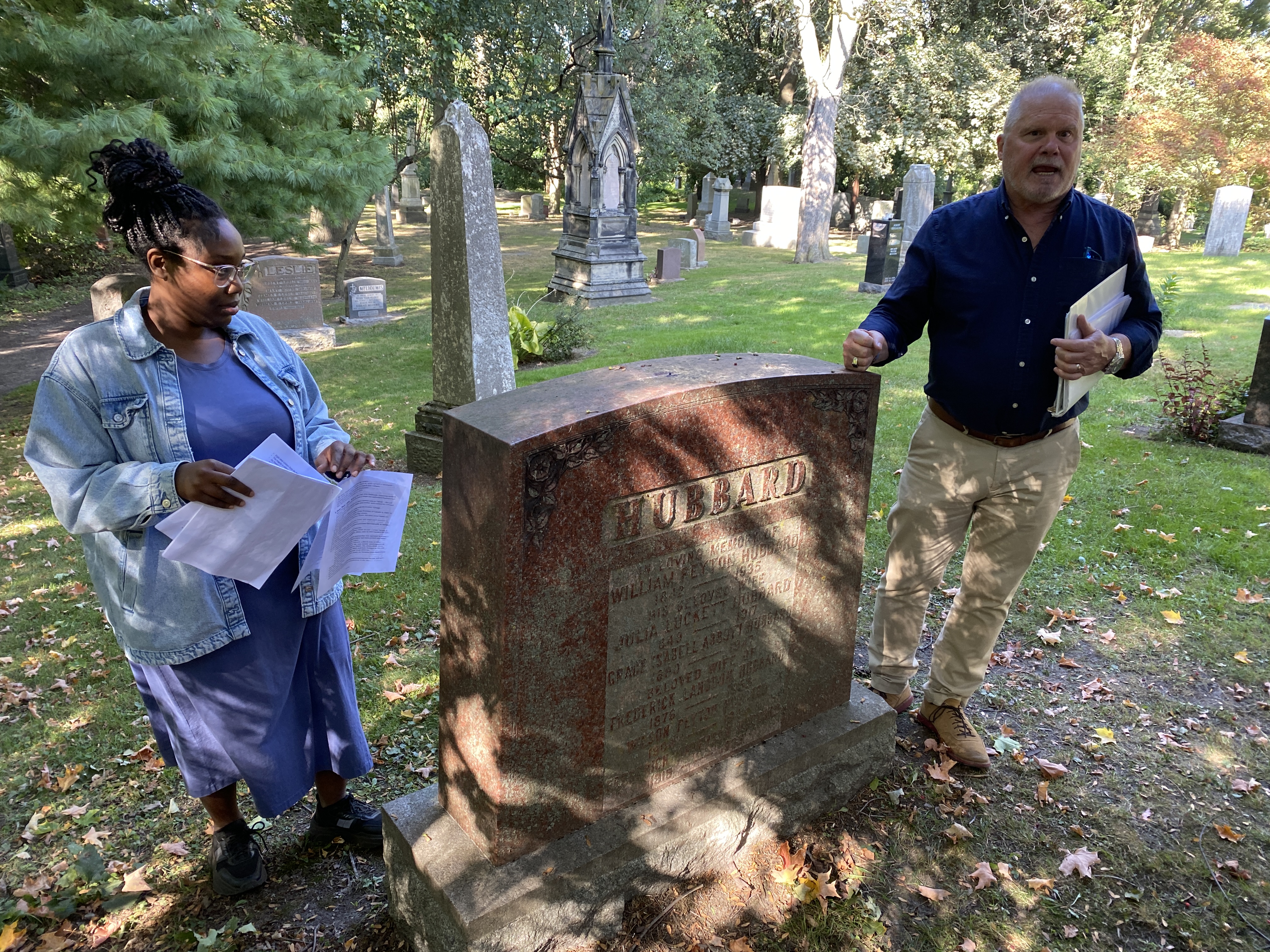


Our final stop was at a large gravestone for William Peyton Hubbard (1842–1935) who was the first person of African heritage to be elected to city council and was known as “Cicero” for his oratory skills. Although he has a prominent grave marker with his whole family listed, he is actually buried a few yards away across a public path through the cemetery. There was another myth circulating that he rescued newspaper publisher George Brown from drowning in the Don River when the cab he was in went into the river, but Hubbard denies that this happened although he was friends with Brown who was instrumental in encouraging Hubbard to enter politics. 


Another very interesting walk where we gained some more knowledge of the history of Toronto. 

Monday, September 18, 2023

Modern Scenes on St. Claire

A Modern Building

When you hear something referred to as “modern”, you think of things recent or new, but in fact, I discovered that when referring to architecture, “modern” refers to building built in the 1960’s. Duh . . . I did not know that.


I got a notification on an online newsletter for a walking tour of “modern” buildings on St. Claire Street. This was a reasonable distance from the condo and easily accessible via the subway, so I decided to register for the event. It was being run by The Toronto Heritage Society and the tour leader was a photographer, so I was interested in not only learning something about the city but also the picture taking aspect of the tour. 


The tour started and ended at the St. Claire/Yonge St. subway station and it was only two km

The subway station at St. Claire

long and mostly on city sidewalks. All we actually did was walk around the city block where the subway station is located. 


The actual theme of the walk was about the “modern” architecture on St. Claire St. I discovered that the “modern” referred to the buildings built in the 1960’s. The subway was extended up to this area of the city in the 60’s and the area rapidly expanded as a popular residential area. The leader is a photographer who is working his way around the city recording all the buildings from this period of the city’s history. He stopped and explained the features of various commercial, residential, and government building. For example, did you know that buildings built with brick, usually have five rows of bricks laid lengthwise and then one row laid with the narrow side facing out, or that zig-zag patterns were popular in “modern” buildings? 


The "Ugly" building (In the back)

Personally, I found that most of the buildings he was so fond of were kind of boring, and one building from the 60’s that he said had been ruined when it was renovated recently, I felt was actually quite attractive. He felt that it would have been better to have been torn down, but I laughed with  another participant that in ten years we would be going on a tour which focused on the “ugly” buildings which he disliked. 


At one point he explained how one building was one of the most beautiful and advanced “Condo” building in the area and actually started the concept of the “Condo”, where people actually owned their apartments. He explained that he had been in the building’s entryway, but would have liked to see one of the actual condo’s, but that most of them were still occupied by the original owners so he wasn’t even able to pretend to be interesting in purchasing a “for sale” unit. He was pleasantly surprised when a lady along on the walk, came forward and said she lived in the building and had been there since it was built and was willing to invite him to come visit her condo. 

Discussing the tour


Not only did I get a nice walk in, I met some nice Toronto folks, and I learned a bit more about the city. I will be watching the society’s website for any other interesting walks. I notice that there is one about the Necropolis in my neighbourhood that might be interesting?


Below are some of the "Modern" buildings we visited.


Can you see the Zig-Zag wall here


Tuesday, September 23, 2014

Bicycles


The Dutch love their bicycles. I’m sure the country has many more bicycles than cars; it sure looks that way visiting Amsterdam. During a walking tour I got to experience the Dutch bicycle culture from a pedestrian perspective, and it ain’t a pretty picture.

When we managed to make it to Amsterdam in time to catch the boat, it also gave us time to take the walking tour of Amsterdam. The ship puts on a walking tour as part of the package in every place we stop. These tours utilize local guides, and so far they have been very good. They all speak English and use an in-ear audio system that allows you to hear them clearly from quite a distance. I’ve used these systems previously, and they are not always that good, but Viking’s system works great.

Bicycle Parking
As soon as we got off the ship we were warned about the Dutch bicyclists. Our guide cautioned us, “Do not cross when bicycles are coming, even though it is a crosswalk and they are required by law to stop they will not.” Following his lead we waited for a break in the bicycle traffic, and rushed across the bike lane.

Walking through the downtown of Amsterdam bicycles are everywhere. Most streets have long bike racks and these are crammed with bicycles, sometimes with additional bikes on top of others. The official bike racks do not come close to accommodating all of Amsterdam’s bicycles and every fence, railing, post or anything solid is covered with bicycles, chained there with massive bike locks. Walking down one street bordering a popular museum, I asked for a translation of a sign posted to every window, and discovered that is was a dire warning against locking your bike to the window bars. I then noticed no bikes on this street.

An interesting note about Amsterdam’s bikes is that they are all old and shabby looking; you see no fancy 18 speed bikes or slick road racers, these are all very solid utilitarian bikes. Our guide explained that everyone owns more than one bike, and indeed everyone has a fancy bike that is used for rides where you return home immediately, but the bikes parked downtown were used to drive to work and you never left your good bike here or it would be stolen, so everyone had a “beater” that was carefully aged, rusted and battered to be used everyday.

Personalizing your Ride
We were told to notice the stickers on some of the bikes. They were put there by the city and noted how long the bike was there. Anything left for too long was cut free and trucked about 15 klm out of town to a bike compound where you had to go ransom you imprisoned bicycle to get it back; an effective deterrent to long term storage on public property, but certainly necessary judging by the massive bike jams downtown.

I noted that the Dutch have adapted to cell phone use on bikes very well. I saw  many one handed bike-texters. Apparently there is a law against “Texting while driving” in Amsterdam that applies equally to bikes, but it is universally ignored, (Sounds familiar)

Walking back to the ship, we were again warned about crossing the bike lane carefully, and our guide deliberately challenged one biker by stepping into the marked crosswalk, but the rider refused to slow down and swerved around him uttering something in Dutch that our guide declined to translate . . .