Saturday, December 13, 2014

Gingerbread

Just when you think you have your travel itinerary all charted out, something comes up and throws another event in. Fortunately, our trip to Houston was pretty casual, and we waited until we got here to figure out how to spend our days. Good thing, because we discovered that there was a huge Gingerbread House competition going on not far from our hotel on Saturday.

Good so far . . .
Now this is no ordinary Gingerbread  House competition; it is put on by AIA Houston, an Architecture Association in Houston, so these houses should be well designed.

We walked down in the morning and got to see the beginning of the process. Everyone was checking their designs, and teams were cutting out pieces of Gingerbread and getting materials ready. Even at this early stage we could see that there were two distinct camps, those that made really fancy traditional Gingerbread houses and those that used gingerbread to make something really cool. There was Star Wars, Frozen, Disney Princes Castle, Shrek, Houston City Hall, The Titanic, and many others.
Under Construction

You could easily see that some of these teams were dead serious, with uniforms, team hats, or matching T-Shirts. The rules seem pretty simple; there is a set limit to the size of the base, gingerbread is provided, but teams could provide their own, all material must be edible, and nothing can be pre-assembled or pre-cut. After wandering around watching the beginning stages of the construction, we decided to explore elsewhere and return to see the finished houses near judging.

Cool, but not much Gingerbread
After a trip to an outdoor skating rink (Yup, skating in Houston at 22°), retrieval of a lost hat (mine, not Regis’) and a wine shopping trip, we returned to the competition. The world globe was sitting on the base rather than elevated on candy cane legs, and the Titanic had completely collapsed, but most teams were just putting the finishing touches on their creations.

Grand Hotel Budapest
My favorite was the Grand Hotel Budapest, because it was really a traditional Gingerbread house of extreme proportions, but the 1950 woody wagon with the Airstream trailer was an emotional favorite even though there was not a piece of gingerbread to be seen.

We did not get to see who actually won, but check out the website when it is updated with the 2014 winners.

Thursday, December 11, 2014

Under Houston

-->
Under Houston
The first year I retired, I accompanied Regis on a “Business” trip to Montreal, and I discovered the lengthy underground tunnel system there. In Montreal, I can see the benefit, with four feet of snow and -20 C temperatures, so I was surprised to hear that Houston, Texas also boasts a tunnel system connecting most of their downtown buildings and attractions. Since our French Canadian friends must want to avoid the cold, I have to assume the Texans are using the tunnels to avoid the 35+ temperatures in the summer.

A walk up to the next block from our hotel took us to a building with access to the over 6 miles (Montreal boasts over 20 miles) of tunnels beneath Houston. An escalator ride down one level put us in the tunnel system.

This is a well-organized and well-designed system, with maps and clear directions. We were able to find our way to one end and then back underground to within a block of the pub where I heard a cold beer calling me for lunch.
Looking up at Houston

Most of the “tunnels” are simply walkways running under the streets connecting buildings, but there are also some sections that are relatively long. Most look like they were designed into the plans for the buildings and contain many restaurants and shops along the way, and all except the last section we explored were purpose built “Tunnels” rather than just opening and connecting basement hallways as much of Montreal is, and most are elegantly finished in tiles and brightly lit with built in lighting.

These tunnels are very well used and I was very rarely able to get photos without people in them. We spent the afternoon exploring this intriguing transportation option in Houston, and although you miss the blue sky and the 20+ weather of Houston in December, I can see the attraction in escaping the heat of August.

And it did lead me nicely back to that cold beer I had calling me from across Houston . . . . .   

Down on the Bayou

-->
Not the nicest beginning . . .
A quote in the magazine Houstonia says “For the longest time, bayous are just one thing to you: EW, which is to say they’re, slimy, teeming with dangerous characters, disease, and secrets – secrets contained in dumped garbage, old cars, the occasional human torso.” Not exactly a glowing endorsement for tourist attractions, but it was down in the historic district and seemed it might be an interesting place to walk along the water.

Our first day in Houston, we went for a walk along the Buffalo Bayou. On the map it looked like a river, and although a bayou is defined as “Chiefly Lower Mississippi Valley and Gulf States,  marshy arm, inlet, or outlet of a lake, river, etc., usually sluggish or stagnant. “, even when we got there, it looked like a muddy river. Fortunately, Houston has made a decision to develop this area, and it has been turned into a quite nice place to walk. There are miles of paved trails along both sides of the Buffalo Bayou, and it seemed to be used by many runners, walkers and cyclists.
A few highways . . . .

This area might have been forgotten and neglected and indeed might have become just as in the above quote, because it does have a few negatives. The ring road around the downtown area of Houston follows the Bayou – probably cheaper to use this land than expropriating useful property for highways, so much of the trail system actually winds under the highways, sometimes three deep above you.

Canoe - not very watertight
The first part of this trail almost put us off walking it, as we saw a number of homeless folk coming up from the trails, but we also saw some cyclists so we decided to try the walk. The first part was a bit rough, and you could see the homeless squats up under the highway supports and I noticed a number of open power boxes where power was being stolen and a few hidden areas where people had obviously been living. All along the trails were signs forbidding “Overnight Camping”, and I imagine it must be an ongoing chore to roust the homeless from the inviting shelter areas under the highways.
Tourists on the Bayou

As the trails progressed it got better and better and turned greener and more developed. At the end there were canoe launches and numerous inviting benches and garden areas. All in all, it was a lovely morning walk “Down on the Bayou”.

Saturday, October 18, 2014

Where are the Cars?


Here is the Mini, Alisha . . . .
Well here it is my last day in Hungary, and I am only now writing my obligatory blog entry on cars. The reason it has taken me so long is because there was not that much to see.


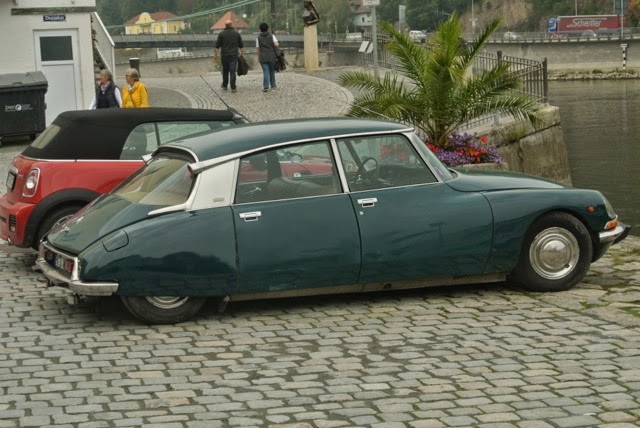
The other day while out walking a brilliant red newer model Ferrari roared by,  there have been a few Porsche 911’s (We did spend a long time in Germany . .), and a nice old red Jag was parked outside a Tobacconist shop in Miltenburg, Germany, but our guide said he never drives it; just parks it on the sidewalk to brag about his wealth, and to show that “He” can park on the sidewalk outside his shop. Other than that, the most interesting are the various Communist era vehicles that survived the fall of the curtain. It was interesting to note that one of the attractions at Memento Park is the East German Trabant car that sits at the entrance.

They are not all in very good shape; while out walking the other day watched an old car try to stop as the driver suddenly realized traffic was stopped ahead. Lots of squealing of “tire”, and smoke, from the one old drum brake that still worked.

More of the old motorcycles seem to have made it through from Communism to Capitalism, and I have found some interesting old bikes.

I did find one very small auto museum of sorts with an odd collection including a Lotus, a Nissan, a no-name truck and a Messerschmitt. As well, walking by an Oktoberfest gathering being set up, I looked down from a bridge at a couple of big old American cars and a Rolls.

Some cars I saw, I could not even identify because they contained no name plates. I figured they were old soviet vehicles that the owners did not want identified.

The most interesting vehicle I saw was a little green thing called a “Jarus”. Doors opened front and back like the Messerschmitt, and it looked the same front or back. The owner told me it was actually made in Nuremberg where I saw it.

Sorry nothing very exciting . . . 


Friday, October 17, 2014

Paprika Overdose

-->
Paprika . .
Hungarians love their paprika. As is usual in our travel adventures, we enjoy living in the country, and eating and drinking as locals. We cooked many more meals than we had in restaurants, and although I have to admit to having one helping of MacDonald’s French fries (It was in the first MacDonald’s to open behind the Iron Curtain), we generally tried to cook Hungarian food, drink Hungarian wine and generally experience the culture, and that involved a lot of paprika.

We arrived on a Sunday, and could not go to the market yet, so we visited a local supermarket and bought some sausage and sauerkraut style vegetables. Frying that up for our first meal in Budapest. I noticed that the sausages were an orange in colour and stayed that shade even when cooked - lots of paprika. 


Turned out to be a pretty good choice as I found a similar dish served at one of the many street food vendors.

More Paprika . . .
Day two I made a Chicken Paprika dish once we had a chance to get to the market and pick up some actual Hungarian paprika. Served with rice and vegetables, this was an authentic Hungarian style dish. The leftovers became a delicious soup the next day – chicken with a distinct Hungarian Paprika taste.

We had friends visiting the next day so wanting to impress them, we prepared the ultimate Hungarian dish, Goulash, all with ingredients from the market. I think it turned out pretty good and everyone seemed to enjoy it. Of course we made a point of washing it down with some Hungarian Bulls Blood. During the communist era, drinking of wine was discouraged, so the people would drink out of an ordinary glass and if asked would state, “I’m not drinking wine, its bulls blood.” Now there are lots of Hungarian red wine called Bulls Blood or “Egri Bikaver”.
Yes, even more paprika . . .

Next came Canadian Thanksgiving; no such thing as a turkey at the market, so we did up a chicken, with Hungarian sausage dressing, and Paprika seasoning on the chicken. The brussel sprouts were not really ‘Hungarian’, but the chicken certainly was. Boiling up the chicken carcass produced a delicious paprika flavored stock that made an amazing chicken soup the next day. Oh yea I forgot mention the paprika salami, and the delicious paprika sausage patties for breakfast.

Yes, sort of overdosing on that delicious Hungarian Paprika. I might sneak some into my suitcase to bring home. Anyone interested in coming to dinner; I’m serving goulash?

House of Terror


With that title, you might think I am writing about a Halloween Haunted house, but no, this is a real house of terror here in Budapest, and in my opinion is one of the best attractions in the city.

When the Nazi army arrived to “Supervise” Hungary’s participation in Hitler’s grand plan for the world, they established their Nazi party headquarters at Andrassy ut 90. The Hungarian Nazi party was called the Arrow Cross, and they brutally controlled the population from this building.

When the USSR ‘liberated’ Hungary from the Nazi alliance, they simply moved in took over the building and continued its terrible use. This is where the secret police operated, using the building as offices, and the basement as interrogation, torture, imprisonment, and disappearance. At its worst, the building itself was the offices, but the communists took over the entire block of basements as a prison. Hundreds were locked up in the old converted coal cellars without trials and most never came out.

The building has been made into an excellent museum commemorating the victims of the terror of two different dictatorial regimes. Not for the faint-of-heart, this is a chilling thought provoking museum. As you slowly tour the exhibits, you are presented with recorded first hand videos of people who survived the terror, or accounts from loved ones who lost people to the “House of Terror”.

The House of Terror
The building itself is painted a dark foreboding charcoal, and has around the top an extended metal lip with the letters “TERROR” cut out backwards so that the sun shining through prints the words on the building. In addition, at eye level, all around the building are small pictures of people who disappeared into this dark place. In front is a large statue of rusting chain representing the Iron Curtain. Inside the building your first image is of a huge German Panzer tank with the Barrel aimed at you as you start the tour. You can easily imagine the terror this terrible building must have instilled in the population of Budapest.

Pictures of victims
All through the museum, the displays are well thought out, with excellent explanations. Each room is different with well-designed exhibits. For example the exhibit on the Russian Gulag is a large empty room with a vast map of Siberia on it showing where these dreaded “Work” camps were located, while around the perimeter black & white video screens describe the experience of victims or relatives. In contrast a room devoted to interrogation (Conversations they were called), places you in a cramped booth to listen to the videos. In the basement they have recreated some of the actual prison cells, the torture chambers and the execution room, but there is no explanation or notes; bending over to walk into the one of the tiny cells was all the explanation needed.

The Iron Curtain
It is obvious that this museum is aimed at “us”, the people in the Western, English world. The Hungarians want us to see how they lived under communist rule. Of all the attractions I visited this one was definitely geared to the English visitor. Subtitles on all videos were in English, English notes were available in every room, and the Iron Curtain statue out front was completely in English. I did not even need the English Language Audio guide; I was able to guide myself around with no difficulty.

A chilling effective exhibit – I definitely got the message.

Thursday, October 16, 2014

Margaret Island


Margaret Island paths
Budapest is a huge city, capital of Hungary, and it has many parks scattered throughout the city. Like most big cities Budapest has one major park, intended to provide a recreation facility to the city. This park is called Margaret Island or Margitsziget. In the 13th century, King Bela IV swore that if God would save Hungary from the invading Tatars he would dedicate his youngest daughter to the service of God. Hungary was saved, and Margaret became a nun on the Island. She found she quite enjoyed the life, and refused when her father tried to “rescue” her later. She became St. Margaret, lived and died on the island and her tomb is still there.
Waiting for Regis . . .

The Monestery
The island is ‘technically’ automobile free except for one end where the hotel is, but as with most of pedestrian zones or areas where vehicles are not allowed, there always seems to be some way around it, and cars are only lessened, not banned. You can rent bicycles, multi-person pedal vehicles, or even “The Villages” style golf carts, so although a pleasant place to walk or run, you still have to watch for vehicles.
Admiring the Statue

The island is a wonderful place to run, and has a proper soft surface running track all the way around, and we saw many runners making use of this. As well, there are paths through every part of the island. There are some small gardens, and a large rose garden in the center, but mostly it is lovely treed walkways. Along the way you can visit a ruined church, the ruins of Margaret’s Abbey, and one complete standing church.

We spent a lovely afternoon wandering the island, and as we were leaving we got to stop and watch the musical fountain to a Rolling Stones song in English.