Tuesday, March 29, 2016

Going to Gallipoli

The Train to Gallipoli
This area of Italy is really not that wide, and although Lecce is close to the western coast, an hour train ride will get you to the East coast, so we decided to take a train and visit Gallipoli.

Castello di Gallipoli
The Italian train system is a good one, the trains get you almost anywhere you want to go, and they appear to run on time. There is a big difference however between the big shiny inter-city trains and the local trains. The intercity trains are long, clean, shiny and fast. The local trains are only two cars long, grubby and not so fast. Yup, it was a local train that was taking us to Gallipoli.

No Wonder the seafood is good!
Gallipoli is a town that was originally completely on an island just a short distance from the coast. Of course the town has spread, and now the island is connected by a convenient bridge, and the train station is a short walk from the old town.

Crossing the bridge, you are confronted with an imposing fortress, obviously needed to protect the town; so vulnerable to invasion by those troublesome Turks of old. In fact the entire old town is built on a raised sea wall which surrounds it all. We started our self-guided tour by walking the perimeter, following the wall around the city as we looked for a place to eat. We had been told that the seafood was amazing in Gallipoli, so we wanted to sample some.
Wandering the streets of Gallipoli
Not sure what this is about
Finding a restaurant suggested by our guide the previous day, we stopped and examined the menu. It looked delicious, but when we requested a table we were ushered to one by the back door. We said we wanted a table out front by the ocean, but were told the were all "full". When I pointed out that the restaurant was completely empty, he pointed to his watch, indicating that it was 1:50 pm. I had forgotten about that 2:00 to 4:00 thing again. Now I know what everyone does during their "break"; reserve the best tables in town. A bit annoyed, we elected to try elsewhere.
Once you leave the sea wall walk, the town is much like the other small town in the area, with narrow winding streets and whitewashed stone buildings. We were a bit disappointed that none of the churches were open, but, it was Easter Weekend and many places were closed.
The castle however was open, and we spent an hour or so exploring this attraction. The castle/Fort has been partially restored, although in some places it was very confusing, and one spot had a display about a gate and chain bridge, but it was difficult to even picture this in its present configuration. Unlike the castle in Bari, which we were disappointed in because so much of it was closed or blocked off, here we were free to explore much of the old castle.
A fort colliding with a castle


Arriving back at the train station for the ride home to Lecce, we were pleasantly surprised to find a sleek red modern train waiting, but part way home we were told we would have to change trains, and at that point we were shuffled back onto the little local train, which was already mostly full with a wide variety of passengers, from a Justin Bieber "wannabe", young girls dressed for a night on the town, or a friendly group of North African street vendors, one of whom got off at each town. The last of them knew I was going to Lecce, and made a point of telling me that my stop had come, for at that point it was dark, and you could hardly see out of the grimy windows to see the dimly lit station platforms. 

Alberbello's Trulli

Town of Trulli
Alberobello is a town north of Lecce that is known for its unique style of houses called Trulli. These houses were featured on one of our favourite travel sites as a possible rental, and it was because of this that I suggested we visit the Puglia region of Italy. After extensive research, we are not renting a Trullo, but I still wanted to visit the town known for them.

Trulli Street
A Trullo is a circular house with a conical roof, and are made entirely of stone. The style developed as a means of beating the tax man, a popular sport in Italy I am told. The Trullo was originally a temporary shelter built by farmers or animal herders, and are actually similar in design to our Canadian igloos. The Inuit use blocks of ice, the Italians use stone. Because the original Trulli were built without mortar they could be taken apart when their occupants moved on. Of course the resourceful Italians quickly discovered that because they were considered "temporary" shelters they were exempt from taxation on houses, and of course, no building permits . . . The simple domed stone shelters grew circular rooms under them, and unique stone roofs made of sloping stone tiles were added. Next it was discovered if you built two side by side you could have multiple rooms, and there are even two story Trulli. As you drive around the area you see large Trullo estates with five or six domes, and many now have swimming pools and other modern luxuries. I am told that the swimming pools are in fact "water storage tanks" in case of fires; again to avoid taxation on luxuries.
Tourists . . . .

Unique Trullo construction
This has backfired slightly on the residents of Alberobello however. The "Town of Trulli" was named a Unesco Heritage Site, and now, not only cannot these once temporary shelters be torn down, any new construction in the town must be based on the Trullo design. There has however been a tourist boom as everyone, me included, wants to visit and see these unique buildings.

Yup, even a Trullo Church
Alberobello was included as part of our tour of the region, and it was interesting to wander through the section of town entirely composed of Trulli. Even the church is a Trullo. You can see clearly the original structures compared with the newer ones because now special stones creates nice even roofs where the original ones are much more irregular and rougher.
Inside a Trullo


I am told that the tax laws were changed so that you now do have to pay property tax on your Trullo house.

Monday, March 28, 2016

On the Terrace

Our Lecce Terrace
Although I normally enjoy writing a blog entry about the weather to create jealousy in my friends back in the still-frozen north, this trip I cannot do so with honesty yet. Apparently southern Italy has had an especially wet cool spring this year, so although I am enjoying the 10 to 15 temperatures (that is Celsius for my US friends), the locals are still dressed in big puffy winter coats and wrapped in scarfs for warmth rather than style.

The Church down the street
The morning after we arrived we were able to sit outside for breakfast, but it has been far too cold and damp to do so again until today. I am writing this blog entry out on the terrace in the sun with a glass of local red wine. I could probably do the task easier inside where the IPad would be easier to see, but the sunshine was calling and I refuse to move inside.

Through the Big Green Doors
One of the nicest features of this apartment is this terrace. It is a huge 30' by 20' space off the main living area and overlooks the hotel courtyard. There are lounge chairs and a nice table for four. Off in one corner is an area for hanging out clothes.

The Crowd Outside
Although this apartment is in almost the exact centre of the old city of Lecce, and outside the main door of the attached hotel, hundreds of pedestrians, bicycles and vehicles make it one of the busiest streets in the city, but sitting on my terrace the loudest noise I can hear is the amorous pigeon looking for attention.

As you wander the narrow streets of Lecce, you will see large 20' high arched doors. These large doors lead through passageways to courtyards open to the sky, but remote from the street. Our terrace and apartment is at the back of the courtyard, so we are pleasantly isolated from the hustle and bustle of the city even though we are located right in it's heart.

Oops, time to go refill that wine glass while I wait for that cloud to get out of the way.

Sunday, March 27, 2016

Stopping at Mama's

Mama's Olive Farm
This region of Italy is known for olives, and coming in on the train, you can see the distinctive grey/green of the olive trees everywhere. Some of these olive trees are hundreds of years old, and a tree that produces good olives is a valuable investment. They prune and trim these trees every year to get the best harvest, and in the fields you see everything from little thin new trees to ancient, knarled twisted veterans of many harvests. We were told that trees have been stolen, dug up and planted in someone else's farm, so valuable trees often have GPS transponders hidden in them so thefts can be tracked.

Ancient Olive
On a tour of the Region, the friends who were visiting us asked the guide about how to prepare olives to eat. She has an olive tree in her yard and tried unsuccessfully to make the fruit edible. He tried to explain, but with the English/Italian, and his actual lack of first hand knowledge, he took out his cell phone and called his Mama for advice. As a result we ended up being invited to her house which was on the way, for advice from an expert.

Yum!
It was obvious she was an expert, as we drove down a long narrow driveway lined with fields of freshly pruned olive trees leading to a big old white Italian farm house. Mama lives here with her 90 year old parents, and her two boys, one who was our guide and the other who was carrying on the family olive growing tradition.

Posing with the Family
We were served two large plates of mama-made olives, red and green,and as the cheese man arrived we also got to sample some local cheese. Then via translation we were given a detailed explanation of the art of olive processing.

You need to soak them in what kind of soda?

They need to be soaked for how many days, and the water has to be changed how many times a day?

Laurel leaves, where do I get Laurel leaves?

I think our friend has decided that her olive tree will remain largely ornamental.


Tuesday, March 22, 2016

Two to Four


Where'd Everyone Go?
It was suggested we call ahead to let the folk at the apartment know when we would be arriving, so once we had our train tickets, we did so. We were informed that it would be better if we caught an earlier train or a much later one, because our arrival, at what we felt was a convenient 2:00 pm, seemed to fall when the reception desk would be closed for a two hour "break". As it happened, we arrived before break time and did get checked in.

I thought this afternoon "siesta" was a Spanish thing. We discovered it in Spain and learned to live with it there, but did not expect it here. Apparently it is a Mediterranean thing.

The whole place shuts down for two hours in the afternoon. Well, not actually everything, but a significant part of the population shuts the doors, pulls down the shutters and turns out the lights at 2:00 pm. At 4:00 pm suddenly everything comes alive again.

We have not quite gotten the hang of this yet, and we always seem to be out looking for something, or wanting something done, when everyone disappears. I have suggested to Regis that we need to start living on "Italian time" while we are here, but she always seem to need something at that time.

I am not sure what everyone does between 2:00 and 4:00. They do not work, that is for sure, perhaps they go home and have a big mid day meal and take a nap or other things you do behind closed doors.

I do not know how this works with people who commute, where do they go for two hours? I'm just going to have to continue to explore this concept. Don't call me for two hours, I'm taking a break.

Monday, March 21, 2016

About Lecce, Italy


The Streets of Lecce
Street From The Roof
We are staying in a city called Lecce. It is one of the most important cities in the southern part of Italy. Dubbed the "Florence" of the south, it houses a lot of the bureaucracy and administration for the Puglia region. It has been an important city for over 2000 years, and it's location in the south meant that it was often attacked by invaders. In the early 16th century the city was fortified and a wall erected around the entire city. These walls still define the old section of the city.

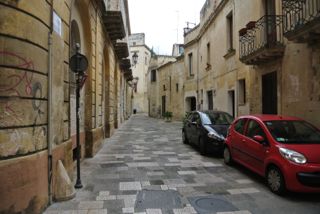
Our apartment for the month is almost right in the middle of this old section. As a result, all the streets are narrow and the widest ones are really only one lane wide. They do allow vehicles in the old city, but they must compete with pedestrian traffic. Many streets are too narrow for any car to use. The buildings are all old and most are only a two stories (well three really because in Europe they call the ground floor "0"). Of course the churches are all taller, and looking out over the city they poke their bell towers above everything else.
The Church is Tallest


Cars, Bicycles, People & Statues
Fortunately, our apartment is on an almost straight street, and we have been able to find our way around by staying on this road, but when you wander off the main streets, it is easy to get confused as the streets go in all directions, turn around and double back. I am slowly exploring and finding my way around.

Now you know a little about Lecce, Italy.

Sunday, March 20, 2016

Living in Lecce

Living Area
Well I must admit that my “travel advisor” did a good job this time. This apartment in Lecce is without the doubt the nicest we have had, and we have had some good ones. 

Guest Room
It is huge and everywhere you look there is storage and shelves. It is decorated with an odd mix of antique furniture and modern touches. We have a foyer that is bigger than a Japanese hotel room and you do not use it. Our bedroom is huge, has a king size bed that is very comfortable, and has a large closet. There are two bedrooms and both have an on-suite. the guest room is actually down a half set of stairs, so it has a feeling of privacy. 
Master Bedroom

Foyer
The kitchen is a bit of a disappointment, as we intend to do a lot of our own cooking. It is small and not well equipped with little things although has a good stove, oven and fridge. It will work, but we have had to ask for simple things like a plug for the sink and pot-holders. They have promised to find things we need however. 

View from Roof
There is a very large private terrace right off the living area where we have already been able to eat breakfast there the first day. The sun is on it most of the day. We also have access to the hotel terrace which is the entire rooftop and has many little sitting areas and is covered with interesting plants.  So far I have never seen anyone up there; although it is lovely and warm for us Canadians, they Europeans are still wearing winter coats gloves and scarfs. 


The only thing really missing is a view. We can see all over the city from the roof, but it is just other rooftops as far as you can see. Our other apartments have had a view of the sea or a river. This is the first time we have not been able to look out to see water - must be the maritimer in us . . . .
Breakfast on the Terrace